When people started approaching John Turchi, PhD, about throwing his name in for a new leadership position at the Indiana University School of Medicine, his initial response was less than enthusiastic. He had plenty of responsibilities running his own research program and leading the newly launched Tom and Julie Wood Center for Lung Cancer Research at the IU Melvin and Bren Simon Comprehensive Cancer Center.
The job in question was chairing a newly merged department — combining biochemistry and molecular biology with pharmacology and toxicology — something Turchi referred to as an “arranged marriage” that nobody in either department had initially sought. Yet he could see the potential to build something that would strengthen scientific discovery and accelerate cures for diseases.
“I don’t even think I told my wife I applied until I got through the first cut,” said Turchi, who became the inaugural chair of the combined Department of Biochemistry, Molecular Biology and Pharmacology in October 2025.
Turchi had a lot going for him. He was trained in biochemistry but previously held a primary faculty appointment in the Department of Medicine’s hematology-oncology division, making him an impartial leader for the merging departments. And he’s not an outsider — he’s been at IU since 2005, when he was recruited by Lawrence Einhorn, MD, an IU Distinguished Professor known throughout the world for developing the first platinum-based drug therapy to cure testicular cancer.
“Of the dozens of people I’ve recruited over the years, I’ve been most proud of John,” Einhorn said. “He’s so committed to improving the field of lung cancer but equally committed to the young faculty under him who are learning to do elegant research of their own.”
The goals of the departmental merger fit with Turchi’s longtime passion for developing better treatments for diseases. Biochemistry and molecular biology aim to uncover the biological mechanisms behind cancer, diabetes, Alzheimer’s and other diseases, while pharmacology uses those discoveries to develop new drug targets, therapies and cures.
“The response from faculty of both legacy departments has been incredibly focused and uniformly supportive of trying to build this as the premier laboratory, computation-based engine of research and discovery at IU,” said Turchi, an internationally recognized researcher in DNA repair and cancer treatment with over 100 publications in the field.
Turchi has secured $9 million in research funding from the National Institutes of Health — including $6 million just within the last five years. In 2009, he co-founded a biotech startup, NERx BioSciences, to commercialize his lab’s discoveries and produce new, targeted drug therapies for difficult-to-treat cancers.
Accelerating drug discovery through team science

Turchi’s initial inclination as an undergraduate at Clemson University was to study architecture — until a lacrosse teammate interested him in becoming a biochemistry major. Now Turchi is a different kind of builder.
At IU, he aims to build one of the nation’s top basic science departments and “leapfrog” ahead of other public universities in grant funding for translational research that leads to medical breakthroughs. During an uncertain time for federal dollars, many medical schools are pulling back on hiring. Turchi’s taking the opposite approach.
“We’re going to recruit like crazy,” he said. “It’s risky, but I look at this as an opportunity. When NIH funding comes back, we’ll be ahead of the Big 10 schools that cut programs. We will have better grad students and get faculty who can’t get what they want at other universities. When it does come back, we’ll blow them away.”
Ever a team player — he’s participated in recreational ice hockey for the past 20 years — Turchi recognizes that science is a team sport. Superstar researchers are great, but it takes interdisciplinary collaboration to develop novel experiments, discover new biochemical mechanisms and translate those discoveries into drug therapies that work.
Using lung cancer as the model, Turchi aims to expand drug discovery programs for other diseases including diabetes, chronic pain, cardiovascular disease, dementia and hard-to-treat cancers. A key will be growing the department’s expertise in computational pharmacology, which uses computer-based techniques, including artificial intelligence, for modeling and data analysis to speed up the process.
Turchi also plans to do joint recruiting with the Division of Hematology and Oncology to attract top physician scientists with the expertise needed to expand clinical trials in cancer.
Ronald Wek, PhD, the Showalter Professor of Biochemistry, said Turchi is successfully building a joint leadership team and establishing clear, shared goals for the merged department with a strategic plan that involves innovative collaborations, equipment for new technologies and valuable new hires.
“This is an especially exciting time for the department as new discoveries in biochemistry and pharmacology are being adapted for new treatments and potential cures of cancers, diabetes and neurodegenerative diseases,” Wek said.
Patrick Sheets, PhD, an associate professor from the former pharmacology department, said he appreciates Turchi’s sincere willingness to listen as he aims to capitalize on the strengths of faculty from both legacy departments.
“He understands that this department is composed of highly experienced and talented individuals at every level, and he has shown respect for that expertise while helping us move forward collaboratively,” Sheets said.
Mentoring rising cancer researchers
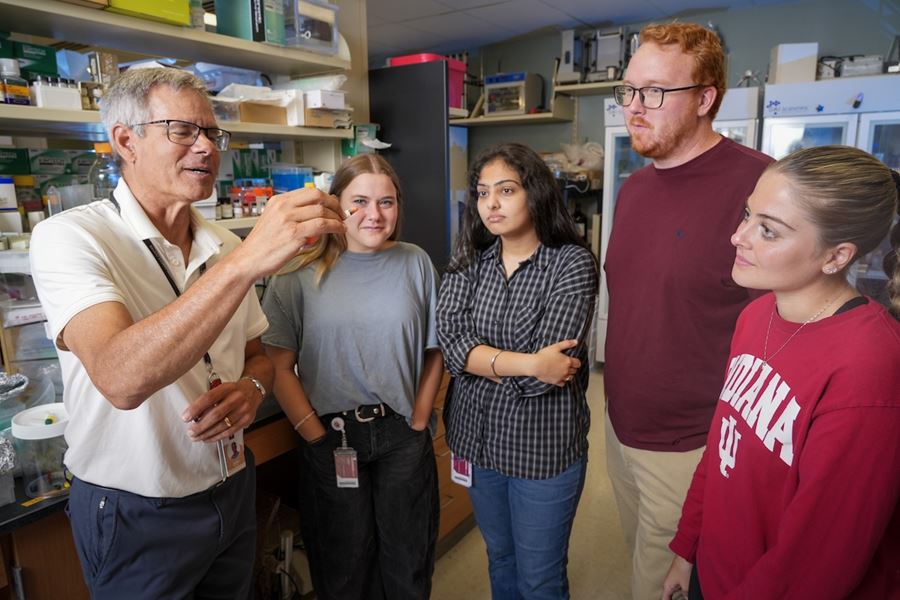
Although he now has more administrative responsibilities as department chair, Turchi still makes time to “fly by the lab” every morning and afternoon to chat with his team. He currently has three PhD students whom he says bring “enthusiasm and spark” to the work.
As a mentor, Turchi is tops, said Shadia Jalal, MD, a physician scientist who learned how to do research from Turchi 20 years ago. He not only taught her technical skills but also helped her develop the grit and humility necessary for scientific discovery. Now she is the Lawrence H. Einhorn Professor of Oncology at IU School of Medicine and interim director for the Division of Hematology and Oncology — Turchi’s former division.
Turchi reframed “failure” in the lab as learning, and he was transparent about his own scientific setbacks, she said. Jalal could always trust Turchi to provide his honest advice while ultimately respecting her decisions.
“Mentorship doesn’t mean everybody has to follow his path,” she said.
Many of Turchi’s trainees have stayed at IU or gone to other academic institutions, while some now work for pharmaceutical companies. Katie Pawelczak, PhD, trained under Turchi when he was on faculty with Wright State University in Ohio and then moved with him to IU to complete her PhD. Today she serves as chief operating officer for NERx.
As the startup’s chief scientific officer, Turchi calls Pawelczak “my boss,” as he also playfully referred to Jalal in the hematology-oncology division. “It’s wildly satisfying,” he said of the feeling he gets when he sees his mentees ascend to positions of leadership and become his colleagues in cancer research.
Turchi tries not to take himself too seriously, which carries over to how he talks of his family and out-of-office pursuits.
“There was a short window when I was the smartest Turchi on campus,” he joked — a couple years between the time his wife Karen, a psychometrician, retired in 2021 and his oldest daughter, Alaina, became a medical student on the Indianapolis campus; she’s now a chief resident in the Internal Medicine-Pediatrics program.
 When Alaina leaves to start a fellowship with Children’s Hospital of Philadelphia in July, Turchi said he will be reinstated as “the smartest” — unless his other daughter, Meg, a traveling emergency medicine nurse, takes a job at IU.
Turchi got his pilot’s license 10 years ago, and the family’s lab-border collie mix, Penny, was rescued through his volunteer work with Pilots N Paws, an organization that transports animals across state lines from kill shelters to foster or adoptive families. Penny loves to don her “doggles” and accompany Turchi in the air, but she isn’t allowed to ride along when he’s on a mission.
“She gets very jealous if I leave on a Saturday morning and she doesn’t get to go — especially if I come back smelling like another dog,” said Turchi, who also volunteers with Mercy Medical Angels and has flown out-of-state patients to IU Health hospitals for lifesaving treatments.
Although Turchi said he’s surely ruffled some feathers during his time at IU, you’d be hard-pressed to find anyone who doesn’t think highly of the affable leader.
“As a leader, you have to not only be thoughtful and insightful and an innovative researcher, but you also have to get along with people,” said Einhorn of his star recruit. “He is someone that no one can dislike.”