The grim statistics unfolded in real time as Michael Davis took in the scene at a hospital in the West African nation of Liberia.
Children were dying. And they didn’t need to.
It wasn’t an outbreak. They were dying from common respiratory illnesses like pneumonia.
In sub-Saharan Africa, the death rate for children under 5 is nearly 15 times higher than that of the United States and Europe. In Liberia, lower respiratory infections are responsible for more than 12% of all deaths.
As a respiratory therapist, what Davis initially expected to be a one-time medical mission trip to Liberia in 2011 quickly turned into his life’s calling. He co-founded a nonprofit, Partner Liberia, and worked with collaborators to establish the first respiratory therapy school on the entire continent of Africa.
Now Davis, PhD, an associate professor of pediatrics at the Indiana University School of Medicine and a researcher at the Herman B Wells Center for Pediatric Research, has teamed up with Adnan Bhutta, MBBS, division chief of pediatric critical care at IU School of Medicine and Riley Hospital for Children at IU Health, on an initiative aimed at saving young lives through simple, low-cost technology. Partnering with John F. Kennedy Medical Center in Monrovia, Liberia, and with support from Boston Children’s Hospital, they launched Interventions to Reduce Childhood Mortality due to Pneumonia in Liberia, or IMPeL, in spring 2025.
One year later, they are beginning to see results. Nearly 100 Liberian children have now received lifesaving care.
Partnering to end pneumonia deaths
It’s amazing Bhutta and Davis never crossed paths before Bhutta’s arrival at IU from the University of Maryland in 2023. They had both been working on projects in sub-Saharan Africa for years.
“One of the key attractions in coming to Indiana was that IU has a deep commitment to global health,” said Bhutta, who previously worked with faculty from the IU Center for Global Health to help establish a pediatric intensive care unit in Eldoret, Kenya.
 Bhutta already had a vision — and funding through the Riley Children's Foundation — to start a pediatric respiratory care training program using an oxygenation device designed to be accessible in low-resource areas. After a government coup shut down his project in the nation of Mali, Bhutta easily pivoted to Liberia, where Davis’ connections and the newly trained workforce of respiratory therapists made success more likely.
“I was amazed by how much work Mike had done in Liberia,” said Bhutta.
Around the same time Davis was launching the Liberia Respiratory Care Institute back in 2012, a group of students from Rice University were developing a “bubble CPAP” device to save young lives in the African nation of Malawi. Called Pumani, meaning “breath” in the local language, the device prevents upper airway collapse and improves oxygenation using continuous positive airway pressure — the same concept as CPAP machines used for sleep apnea but designed for tiny airways. The Pumani also was intentionally engineered to be low-tech and low-cost.
“The beauty of bubble CPAP is it’s relatively inexpensive, so most governments and hospital administrations are able to buy them and keep them serviced,” Bhutta explained. “It’s also relatively easy for us to train doctors and nurses on because it’s simple to use.”
As a native of Pakistan, Bhutta has spent much of his career trying to improve access to quality healthcare for low- and middle-income countries. In places in the world where most hospitalized children are expected to die, even a small improvement in the mortality rate would mean hundreds of lives saved.
 By the time parents bring a child to the hospital in Liberia, it’s usually a serious illness. In the past two years, about 1 in 5 children who came to the emergency room died. For comparison, that number is about 1 in 1,250 in America, noted Davis.
“Liberia is full of malaria and typhoid, and whenever those patients get critically ill, they go into respiratory failure,” he explained. “So, even if it’s not the lungs that brought them to the hospital to begin with, it becomes the thing that’s going to kill them if that’s not fixed. You need respiratory support, or you might not be able to keep somebody alive long enough for treatments to work.”
Thanks to the IMPeL project, critically ill children at Liberia’s JFK Medical Center are now facing better odds.
“The mortality rate of patients going on CPAP plummeted from nearly 100% when we started this project to less than 25% by the end of November, so we, meaning the team in Liberia, are clearly getting better at doing this,” Davis said.
Building a sustainable system for pediatric intensive care
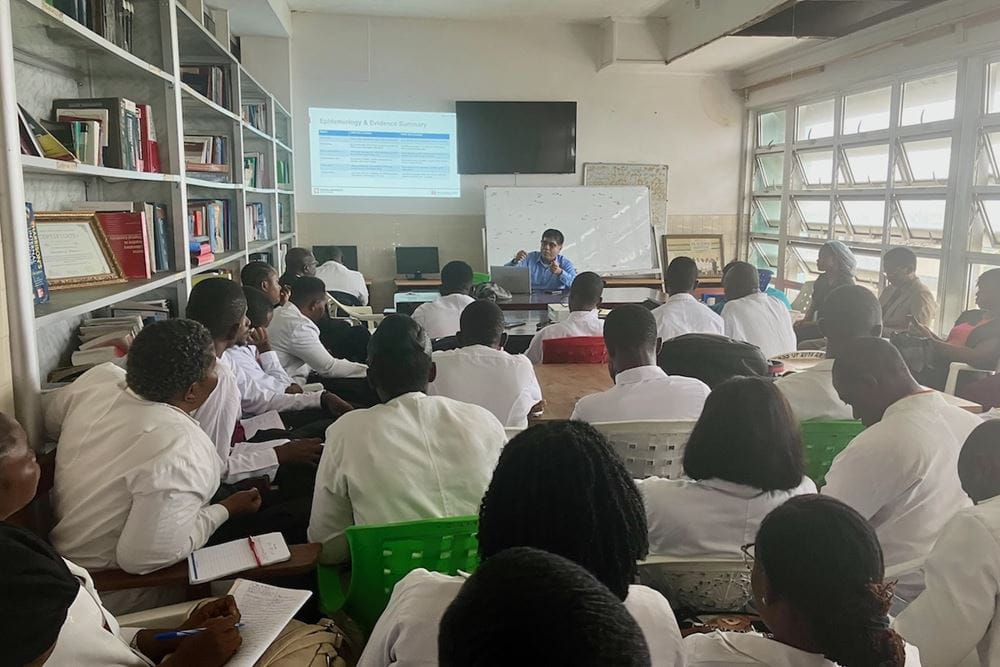
The Pumani has been tried in other sub-Saharan African countries with mixed results. It’s not a design failure; it’s primarily been a workforce issue. That’s what makes Liberia different: Davis and his local team have spent the last 14 years training a respiratory therapy workforce there.
“I think the most important part is this work is being done by the Liberian team with the simple equipment and the training that we’ve provided,” Davis said. “I’ve always said that the mission of my nonprofit is to put me out of a job, because if it takes me going over to do the work, it’s not sustainable.”
Last year, the IU team shipped several Pumani devices to the pediatric department at JFK Medical Center, the capitol city’s largest hospital. Then Davis and Bhutta traveled to Liberia to train the staff. Ebenezer Zoefly, a graduate of the Liberia Respiratory Care Institute and now its head professor, leads the IMPeL program in Liberia. He rounds in the hospital daily and sends reports back to IU on each patient treated with bubble CPAP.
 The IMPeL project also receives data support from Boston Children’s Hospital, which has partnered with the Liberian hospital to grow its pediatrics department over the past decade. Preliminary data shows a trend line of deaths declining among pediatric patients who were given bubble CPAP.
“The children that are still dying are the children that need more than CPAP, which is the most advanced respiratory care we can give there,” Davis said. “But without CPAP, almost every kid we see in IMPeL would die. The ones that respond to CPAP get better — they stay in the hospital and stabilize, and then they go home.”
If data continues to back what the care team is seeing, Davis and Bhutta hope to expand IMPeL to Liberia’s second largest hospital later this year. There’s also a second respiratory support device, called high-flow nasal cannula, the team would like to test in Liberia.
“Our dream would be to have a study in which we provide either CPAP or high-flow nasal cannula and see how well they each work in low- and middle-income countries,” Davis said. “In some cases, high-flow nasal cannula can be a better solution than CPAP, but it is slightly more complicated to implement. So, that’s the next step.”