Photo of couple of people talking

Finding Community in the Nation's Largest Medical School

Inside the new Medical Education and Research Building, Professional Learning Communities make it feel just a little bit smaller.

THE STUDENTS ARE already congregating in the back of their home away from home, laptops open in front of them on study tables, backpacks agape on the floor like open toolboxes. There’s some quiet chitchat — about recent exams, quirky professors and weekend highlights — but mostly it’s heads down, eyes on screens, and scrolling digital flashcards that are a survival tool for first-year medical students.

Soon, more students arrive. A school staffer brings in a box of deli sandwiches, chips and cookies, and the volume of banter in the room grows. In moments, they’re teasing and laughing, and survival mode shuts off briefly. To a stranger, they might seem like high school friends reuniting.

Inside a $230 million building, there are high-tech tools to make laser-thin slices of brain tissue, simulators to train surgeons to use robots, and printers that churn out 3D models of human anatomy. Yet the core of the medical student experience is something far simpler.

It unfolds in a suite equipped with a couch, comfy chairs, dining tables and a glass-walled quiet room for studying. There’s also strong Wi-Fi and a wall-mounted television. Yet in a building with gee-whiz elements on almost every floor, these spaces were designed and outfitted based on a principle as old as cave-dwellers: People will be happier, healthier and more likely to work at their best if they feel tied to a community.

That’s the premise for what the Indiana University School of Medicine refers to as “Professional Learning Communities.” The communities exist on all nine campuses. In Indianapolis, under the glass roof of the Medical Education and Research Building, there are a dozen of them. And on the largest campus of the biggest medical school in the country, they help shrink a student’s world down to a manageable size.

In the spring, each community had just 36 students — a less overwhelming slice of the 802-student population on the Indianapolis campus. The headcount is evenly divided among first-, second- and third-year students, a balance meant to promote peer mentoring and support. Next year, the groups will expand to all four years and grow to 48. Each group calls on a pair of working physicians as mentors. They facilitate group discussions, give insights into their life as physicians and connect the classroom to clinics where students will one day work.

Learning communities have been in place for almost two years on regional campuses and about three years in Indianapolis. But before the construction of Indy’s new building, students on the campus were scattered among multiple buildings and remote spaces. For that matter, so were their classrooms. In the new building, which opened in July 2025, they’re all under one roof. So are the suites that serve as their home base during their four-year stint in medical school.

Each learning community is named after a tree native to the Hoosier State. Paw Paw and Persimmon, Maple and Magnolia, Hickory and Redbud are just some of them. Each has a distinct personality. The Magnolias are a social hub, a place where members are prone to break out board games for fun. Others are more serious. The Dogwoods, as student Harrison Layman puts it, are a good mixture of “focus, study and fun.”

Sam Alakhras, a student from West Lafayette, said he is shy by nature, but that the learning community eased his transition during his first year. “I know all these guys by name now, even though I don’t know a lot of other students here,” he said. “It helps create a sense of community. I recognize them in class. I can talk to them and ask questions.”

That hasn’t always been the case as IU School of Medicine has steadily grown in recent decades and extended branches into eight communities around the state.

Elizabeth Weinstein, MD, director of the learning communities, said students sometimes felt small in “a sea of students.” The learning communities — and their gathering rooms — shrink that distance by creating shared places where everybody knows your name.

“It gives them a space to go both physically, because of the (new building), but also sort of metaphorically providing a cohort of students they are just part of from the beginning and can bond with,” she said.

WHILE IU SCHOOL OF MEDICINE restructured its curriculum in 2017, the first year is still built upon courses that are dense and demanding, it’s vital to supply students with an understanding of the body’s terrain, a precise grasp of its function, the language of their profession and the habits of learning expected of a physician.

But at times, it’s almost overwhelming. The PLCs, as they are known, are designed to fill in gaps. Bill Swigart, MD, a faculty advisor to the Hickory community, said a colleague once summed it up this way: “We spend a lot of time teaching students what to do as a doctor. But not enough time talking about who to be.”

The faculty advisors fulfill a key role in bridging the gap.

For the Dogwood community, Megan Crittendon, MD, and Brent Bagley, MD, fill those roles. They host monthly Doc Talks — hour-long discussions to help students form professional identities.

They invite students to occasional dinners and holiday gatherings and serve as sounding boards.

“I’m not the one teaching their courses,” Bagley said. “I’m not the one writing their tests and grading them. I’m the one who they can talk to about their life in medical school, who they can talk to about the stuff that they don’t teach you about being a doctor.”

Jordan Walker, a third-year student in the Dogwood community, values the insights he’s gained from Crittendon on emergency medicine, a specialty he’s considering. But the mentors’ unofficial influence is also helpful and comes without the complications of grading or evaluation.

At a recent Doc Talk, each community spent time discussing a topic that’s addressed in the formal curriculum only in spots: managing the emotional aspects of being a physician.

In the safe confines of the Dogwood suite, Crittendon, Bagley and their first-year students covered expansive ground. They discussed giving a patient bad news, managing a room with family members when emotions are high, and coping with the loss of a patient.

Questions flowed quickly.

When is humor appropriate with an anxious patient?

“It’s reading the room,” Crittendon said.

How do you know if a patient understands what you’re saying?

“I start by asking what they’ve heard,” Bagley said. “Then I steal their words.”

How do you handle difficult conversations?

“Watch as many as you can,” Crittendon tells them. “You’ll learn what to do — and what not to do.”

Then, the conversation shifted. One student described witnessing the death of a 9-month-old while shadowing in a pediatric emergency room. The room stilled. “I’ve definitely cried in front of patients,” Crittendon said.

“That’s totally OK,” Bagley said.
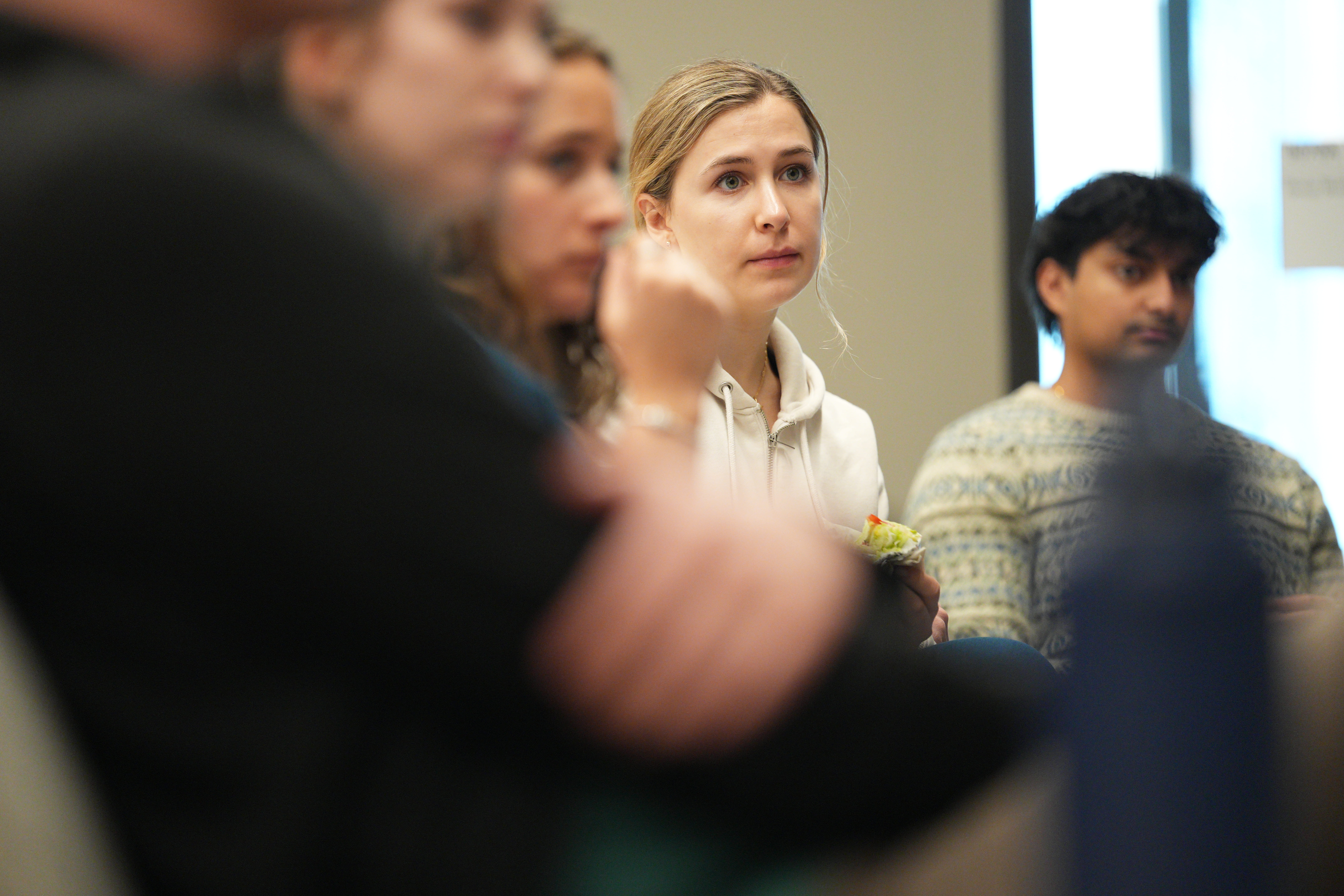
 

Students sit together in a classroom

At a recent Doc Talk, first-year students and their faculty advisors covered expansive ground: giving patients bad news, managing grief, and knowing when it's OK to cry. "That's totally OK," Brent Bagley, MD told them.


IT IS NOT the kind of exchange that would have been common in medical training a generation ago. Here, it is the whole point.

The doctors’ willingness to acknowledge the pain and tears of the job was well received by the students. So were the moments when Bagley and Crittendon admitted to stumbling over their words in patient chats and to sometimes making mistakes.

“You have to have that in medicine. You’re not perfect,” said Brynn Baker, who just finished her first year. “If you don’t have humility, your patients won’t trust you. We’re not here to play God.”

So, in the end, how does having a Professional Learning Community in a big medical school — and giving it dedicated space — help shape better doctors?

“It’s the idea of moving them from being a student to identifying as a physician,” said Weinstein, the PLC director. “It’s building the skill sets that this requires, the ethos involved and the responsibility to the community at large that comes with that.”