
The Room Where Medicine Begins
An open and bright anatomy lab at Indiana University School of Medicine influences how medical students move, learn and collaborate — while reinforcing respect for donors.
Matthew Harris May 29, 2026
WHEN LIZ AGOSTO first stepped into the new anatomy lab, one feature stood out immediately: Natural light filtering in through the second-story windows of the Medical Education and Research Building. That’s no small change. The former lab in the Van Nuys Medical Science Building kept its blinds perpetually closed to prevent people in neighboring buildings from looking straight inside.
“Everything is very crisp,” said Agosto, PhD, who oversees the space and leads the anatomy course at the Indiana University School of Medicine. “Everything is stainless steel and very bright white. So, it reflects a lot of daylight.”
Better aesthetics aren’t the only upgrade in the Diane K. Werth, MD, and Allan S. Manalan, MD Anatomy Lab, made possible by a $5 million gift from Werth in 2024. No more green walls. No more aging fixtures or finicky lights. The new facility reshapes how students move, learn and treat the space.
The fall semester was the first time the lab was used, and we spoke with Agosto about how it prepares future healers. The conversation has been edited for length and clarity.
Q: For someone who never saw the old anatomy lab, what would you say they need to know about how the new one is set up?
The biggest difference is that it’s all one huge, open space now. In the old lab, we were divided into two rooms with these odd little walls breaking things up. So, even though everyone was technically in the same place, it didn’t feel that way. In the new lab, you can see everything the moment you step inside. It’s one big, cohesive working area with all the tables laid out in front of you. It feels like a real shared environment instead of a carved-up one.

The new lab's open layout changed more than the sight lines. "They're more mobile and more curious," Agosto says, "because the room invites it."
Q: Let’s turn to the new lab’s atmosphere. When you walk in, what first jumps out at you?
Honestly? The daylight. The brightness. The old lab had Eisenhower-era green walls and peach-tan paint peeling in places. It was very 1960s basement. Now everything is crisp, stainless steel, and bright white. You get actual sunlight. It doesn’t feel cave-like anymore. I joke about it, but it’s true. It’s modern, and you stand a little taller walking in.
Q: Setting aside aesthetics, what problems does the new space solve?
Navigation, hands down. In the old lab, the class had to be split into two, and people were always doing this improvised ‘see one, teach one’ across rooms because they couldn’t all be in the same place. If you had a question, you might have to weave through a maze of tables and bodies to find somebody. Now, I can see every single table from anywhere in the room. If one group needs more help or another is moving faster, I can instantly shift instructors around. Exams are easier, too. We used to have students running around the room to get through the stations. Now everything’s in one long loop.
Q: How has teaching itself changed for you?
It’s actually easier to be present. I can address everyone at once if needed, and I can spot when someone raises their hand across the room. Before, you were spending mental energy just navigating the space or dealing with the fact that half the equipment was older than I am. Now I can focus on teaching. I’m not taping a light fixture back together mid lab. I’m not troubleshooting monitors. It’s teaching first, maintenance second, which is how it should be.
Q: What about the dynamic among students? Does the new space change how they learn from each other?
The peer teaching itself hasn’t changed. They still work in teams of three on each donor, and they hand off to the next team the following session. But what has changed is how aware they are of the rest of the room. They can glance over and see if another table has an interesting structure or if someone’s working through something they might want to look at later. They’re more mobile and more curious because the room invites it.
Q: Technology also seems like a big leap forward.
Oh, absolutely. We have an integrated monitor system now. I can plug in my laptop at the front, and whatever I’m showing goes to every single screen instantly — in full color, which wasn’t always guaranteed before. And the mobile camera is a game changer. We can show a pathology, a surgical sign, or a really beautiful anatomical variation without everyone crowding around a single table. It closes the gap between ‘here’s something cool’ and ‘here’s how you’d actually see it in practice.’
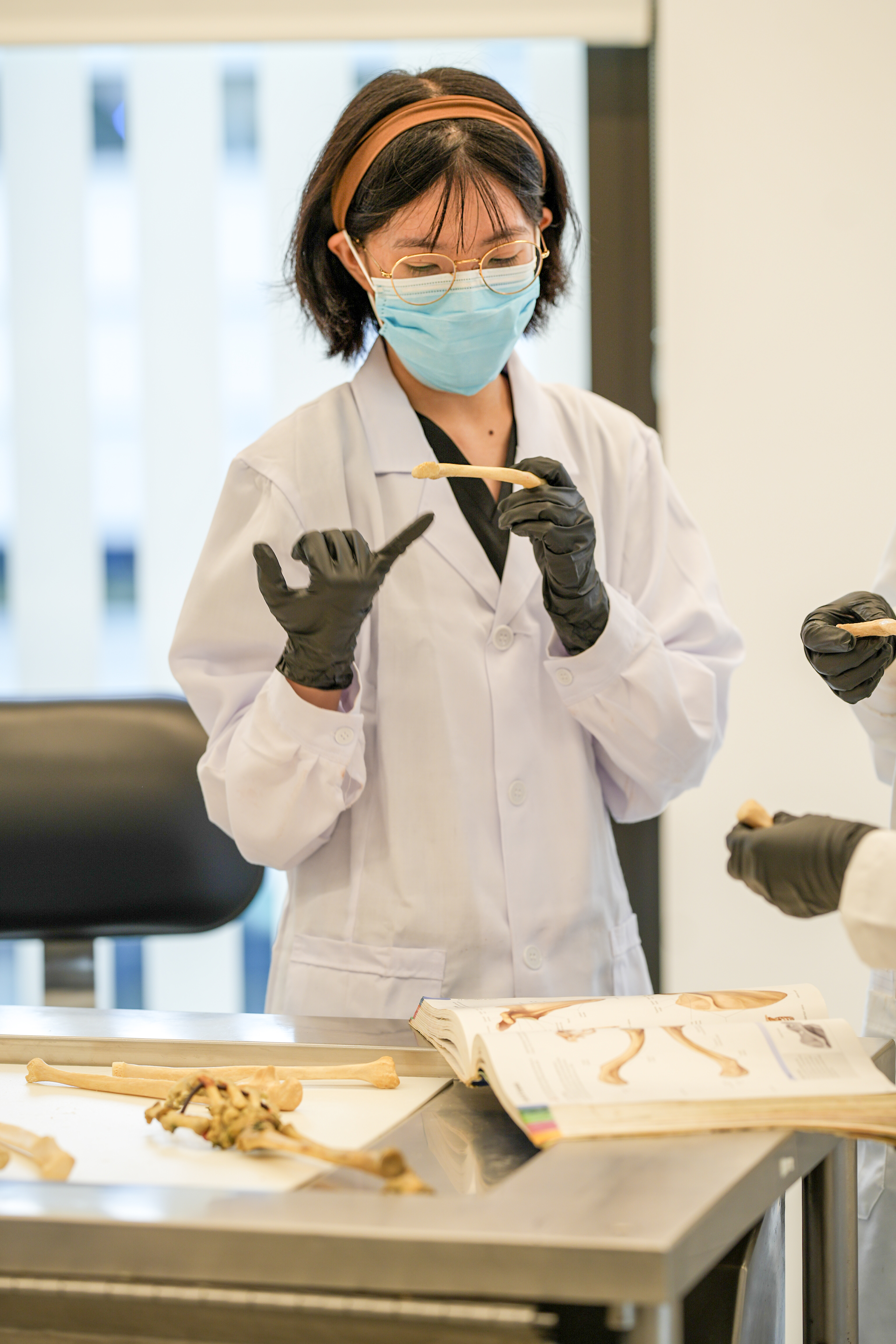
In the osteology station off the main lab, a student studies skeletal material, a small but deliberate design choice that draws a clean boundary between two kinds of learning."
Q: You also have flex spaces attached to the lab. How are those being used?
One is our osteology station, which is great for keeping the skeletal material separate from the donor area. It gives us a clean, respectful boundary between those two kinds of learning. The other has a surgical table and can be used for special sessions — everything from emergency medicine demos to anatomy-focused continuing medical education down the road. Students love anything that bridges anatomy with real-world practice, and the tech lets us broadcast those sessions across the room.
Q: What impact does the new space have on the more personal side of anatomy: respect for donors, professionalism and the emotional experience?
A huge one. The brightness and cleanliness matter. Students take better care of the space without being told. They’re wiping down tools, cleaning their tables and making sure things are put away. It’s subconscious, I think. When a place is pristine, you want to keep it that way. And because this is their first patient experience, that sense of respect is essential. The room reinforces it. It signals, ‘This work is important. This gift is important.’
Q: Is there a feature students respond to most?
Adjustable height tables. It sounds like a small thing, but when you’ve got tall students bending over donors for two or three hours, the comfort difference is enormous. They rave about them.
Q: After a year in the new lab, what’s your overall sense?
It feels like a clean slate — in the best way. We’re still finding new ways to use the tech, still imagining what specialty sessions we can bring in, still figuring out how to leverage the space for students across all campuses. But the big picture is that everything runs more smoothly. The students are more comfortable, the teaching is more fluid, and the space itself supports the kind of respect and professionalism we try to instill. It’s hard to ask for more than that.