“What is your dream?”
That’s the question the pathology department chair at Harvard’s Brigham and Women’s Hospital once asked Jay Hess when he was interviewing for a spot in their residency program. The question stuck with Hess and has guided the way he has recruited leaders at the Indiana University School of Medicine for the past 12 ½ years.
“Ideally, as a leader, you start with people who have a dream,” said Hess, MD, PhD, MHSA. The alternative is making people “fit” into institutional needs.
“It’s easier to start with people who are inspired to do something,” he said, “and find a place for them in your organization.”
This was among the leadership lessons that Hess shared during a “fireside chat” with executive vice dean emeritus and longtime faculty development leader Stephen Bogdewic, PhD, during the Stephen P. Bogdewic Lectureship in Medical Leadership event held in Indianapolis on April 30. It was a stop on Hess’ farewell tour as he prepares to step down as dean and as IU’s executive vice president for university clinical affairs in July.
Hess will remain connected to the school, but he and his wife, Robin, plan to enjoy time in Maine, where they’ll be sailing their custom-built vessel out of Rockport Harbor.
“Sailing is a little bit like leadership in academic medicine,” Hess mused. “You’re utterly dependent on other people when you’re jibing, tacking or dropping anchor. You have a whole team of people who have to do the right thing at the right time … and agree on the direction you’re going.”
 The well-attended event drew an array of colleagues who gathered to hear Hess’ thoughts on leadership and to express their gratitude for his vision as the school’s 10th dean. Following the hour-long, armchair chat, Bogdewic told Hess in sincerity, “You are, without question, the finest leader I’ve had opportunity to work with.”
Many in the room held similar feelings. They used words like “trustworthy,” “collaborative” and “steadfast” to describe Hess’ leadership.
“I appreciate that Dean Hess is a thoughtful and decisive leader — and those two characteristics don't always go hand-in-hand,” said Neil Perdue, PhD, executive associate dean for strategy and enterprise alignment at the IU School of Medicine.
Michael Feldman, MD, PhD, who will serve as interim dean while a national search continues for Hess’ successor, said he shares the dean’s belief that all decisions should be mission-driven and focused on improving patient care.
“It’s easy to align our purpose if we are all rowing in the same direction,” Feldman said.
Aligning the enterprise
Hess has long held the mindset that patients should be at the center of every decision, something that was instilled during his days as a student at The Johns Hopkins University School of Medicine.
“I’ve always felt very strongly that it starts with the patient,” he said, “that whether you work in finance or administration or facilities or whatever, try to connect yourself, in some way, to ‘how does this make lives better for patients?’ That’s really important.”
 Working in partnership with IU Health, IU School of Medicine has built several nationally distinguished programs, including pediatrics at Riley Hospital for Children. Through an intentional focus on precision health, begun as an IU Grand Challenge, IU is delivering highly personalized treatment approaches for diseases including Alzheimer’s, Type 2 diabetes, triple negative breast cancer and other cancers. And an IU Health mobile lung screening truck is bringing CT scans into communities, enabling lung cancer to be caught earlier in high-risk populations.
Perhaps the most visual icon of the cooperative spirit between IU School of Medicine and IU Health is the new Medical Education and Research Building, which opened in 2025 at the Academic Health Center in downtown Indianapolis. IU Health is currently building a 16-story, 864-bed hospital next door. The health system also opened a new hospital next to the medical school’s academic building in Bloomington.
When Hess arrived as dean back in 2013, he didn’t see that kind of enterprise alignment. Concerned about the lack of a shared vision, Hess called a meeting with then-IU President Michael McRobbie and the chair of the IU Board of Trustees.
“I’m concerned that you may have hired the wrong person for this role because I moved here with the expectation that we’d create a top-tier academic health system,” Hess told them. He had relocated from the University of Michigan to take the dean’s role at IU.
That was the beginning of what Hess called “a very deliberate process of enterprise alignment.” He found a kindred spirit in Dennis Murphy, MHA, IU Health’s president and CEO since 2016 and the chief operating officer when Hess took the helm as dean in 2013.
Murphy heard Hess was a strong collaborator who would work hard to get things done.
“All those characteristics were very self-evident within the first several weeks of working together,” said Murphy.
Together, they recruited enterprise leaders who would advance shared missional areas in clinical care, research, medical education and community health.
“The real unique element is that both Dr. Hess and I felt that building excellence across all those areas was a shared responsibility, and I believe that came across to the candidates,” Murphy said. “It allowed us to recruit better people to Indiana.”

Today, IU is nationally recognized for its expertise in Alzheimer’s disease, oncology, urology, cardiovascular medicine and more.
With philanthropic support, IU School of Medicine has opened several new centers and institutes to advance research and cutting-edge clinical care. Those include the Vera Bradley Center for Breast Cancer Research, the Indiana Center for Musculoskeletal Health, the Brown Center for Immunotherapy and the newly established Tobias-Lechleiter Institute for Clinical Innovation.
Mark Notestine, PhD, senior associate dean for development and alumni relations, said he and Hess made a phenomenal team in fundraising, jokingly calling the dean a “really smart” introvert and himself a “half-bright” extrovert.
“He's had incredible fundraising success during his tenure,” Notestine said. “We've documented more than a billion dollars in philanthropy. This is pretty good by any standard.”
Building a culture of excellence
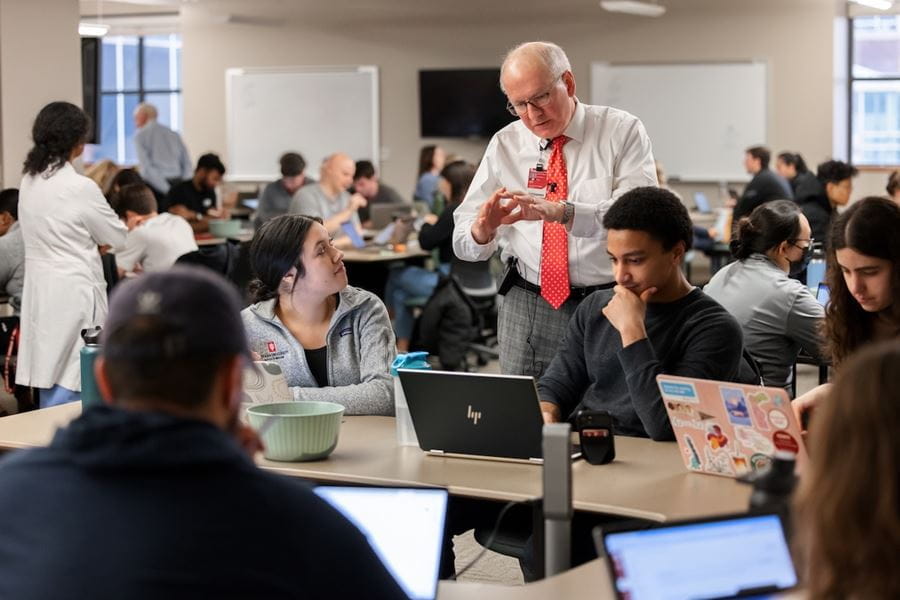
Under Hess’ leadership, IU School of Medicine standardized its curriculum across its nine campuses, improved student satisfaction ratings and achieved two successful reaccreditations. Key leader recruitments include 26 department chairs, eight executives and several research center and institute directors.
During this time, IU School of Medicine has grown its research funding by more than $300 million a year, tripled research facilities space and improved its national ranking among U.S. medical schools. In 2019, the IU Melvin and Bren Simon Comprehensive Cancer Center achieved its “comprehensive” designation from the National Cancer Institute, the only such center in Indiana offering patients access to the most advanced, research-guided therapies. And IU has become an internationally recognized leader in neuroscience research with faculty members winning top awards from the Alzheimer’s Association.
“What is truly unique about what Dean Hess has built over the prior 13 years is the culture of community and collaboration,” said Bruce Lamb, PhD, executive director of the Stark Neurosciences Research Institute at IU School of Medicine. “This style of leadership makes you want to work harder towards the shared vision, and his leadership style filters down to different leaders throughout the school. This is such a critical, but perhaps undervalued, part of the success of our programs within neuroscience and across the school.”
Hess has consistently lived out his belief that “great organizations have great culture.”
 “One of the things that has been really inspiring about Jay in his leadership is just what a phenomenal steward he has been and how brave he will be for the mission of the school,” said Chemen Neal, MD, vice president of strategic integration for the IU Health Medical Group and a former executive associate dean for diversity initiatives at IU School of Medicine. “I think he's a true protector of the academic mission.”
Hess has also been a strong supporter of wellness initiatives and faculty development. Mary Dankoski, PhD, executive associate dean for faculty affairs and professional development, said she appreciates his intentionality in establishing clear “roles, goals and responsibilities.”
But her admiration of his leadership goes much deeper.
“He’s so thoughtful,” Dankoski said. “He’s just steady and very clear. So, you can really trust him.”
Katherine Hiller, MD, MPH, associate dean at IU School of Medicine—Bloomington, said she admires Hess’ servant leadership style and the way he has used his skills to make the school stronger across its nine campuses.
“I also really admire how steadfast he is in his true north,” added Hiller. “When things get really bad — and they have gotten really bad at times — he is very careful about projecting a calm message that our mission and our vision haven’t changed.”
Over the years, Hess has consistently supported the school’s educational mission across campuses for all levels of learners, from undergraduate health professions to graduate students, medical students, residents and fellows, said Bradley Allen, MD, PhD, executive associate dean for educational affairs.
“He understands the benefits of our nine-campus system and has helped us work to improve the functional integration of our faculty across the state with their respective clinical and basic science departments,” Allen said.
Living out his dream
The son of two artists, Hess said his parents often “wondered where I came from” with his early fascination for science. His first connection to medicine came in fourth grade when his mother was diagnosed with breast cancer.

As a high schooler growing up in Connecticut, Hess participated in a science honors program through Columbia University and did research through a summer program with the Cancer Research Institute after graduation.
Although he never thought about becoming a medical school dean until he was in his 50s, his dream of helping people through medical science led him to leadership positions at the University of Michigan and the University of Pennsylvania before assuming the deanship at the IU School of Medicine.
As he prepares to retire from the role, what he will miss most is the people.
“One of the great things about being a dean is you meet hundreds and hundreds of wonderful, interesting people who are very dedicated,” he said.
Closing out their chat on leadership, Bogdewic asked Hess what final message he would like to leave with faculty, staff, learners and colleagues. The dean’s reply was simple yet thoughtful:
“Aim high. Work hard. Be very persistent. But be kind.”
Share a note of gratitude with Dean Hess
IU School of Medicine Faculty Affairs and Professional Development invites all members of the school community to submit a note of thanks, well wishes or a fond memory for a book that will be presented to Dean Hess. The submission form for messages and photos will be open through May 15.
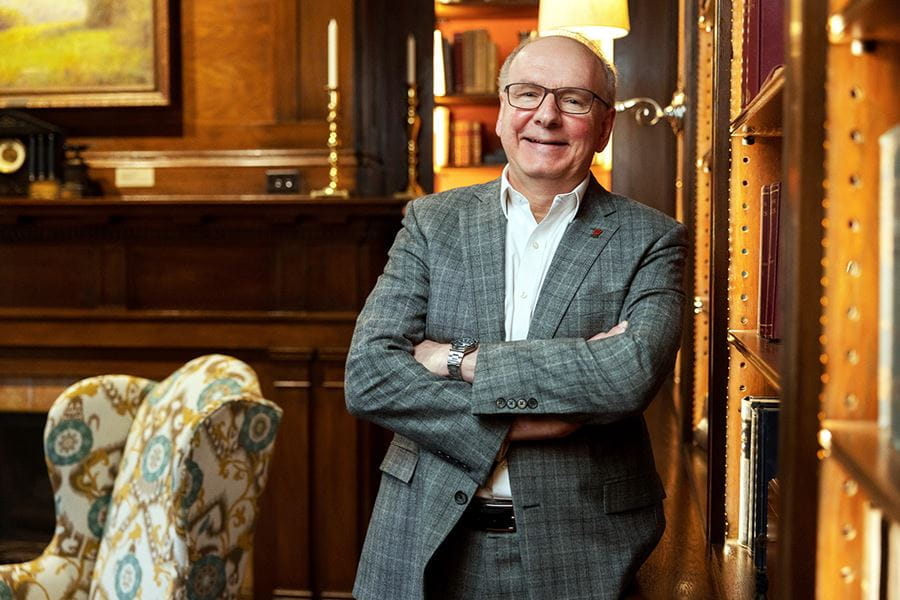
Dean Hess’ Top 10 leadership books
Those who are inspired by Hess might want to read his “top 10” book recommendations on leadership.
- The Leadership Challenge: How to Make Extraordinary Things Happen in Organizations by James M. Kouzes and Barry Z. Posner
- Six Thinking Hats by Edward de Bono
- Getting to Yes: Negotiating Agreement Without Giving In by Roger Fisher and William L. Ury
- Becoming a Conflict Competent Leader: How You and Your Organization Can Manage Conflict Effectively by Craig E. Runde and Tim A. Flanagan
- World Class: A Story of Adversity, Transformation, and Success at NYU Langone Health by William A. Haseltine
- Grit: The Power of Passion and Perseverance by Angela Duckworth
- The Advantage: Why Organizational Health Trumps Everything Else in Business by Patrick Lencioni
- Team of Teams: New Rules of Engagement for a Complex World by General Stanley McChrystal
- Talk Like TED: The 9 Public-Speaking Secrets of the World’s Top Minds by Carmine Gallo
- Made to Stick: Why Some Ideas Survive and Others Die by Chip Heath and Dan Heath