.png?rev=b16dc8c20ba24991bd0bfff1c92193b6&la=en&h=300&w=450&hash=53CC82BCC87C9A74115FB75A6364DC34)
Early in the meeting, the large, clear text on the guest speaker slide deck laid it out plainly:
The question isn’t ‘Will AI be a part of medicine?’ The question is ‘Will you be prepared to use it wisely?’
AI’s continued emergence seems to be a fait accompli — in healthcare and across nearly every major industry. The speakers — William Skertic, Bralin Coleman and AJ Lahade, all of Eli Lilly and Co. — were there to address the inaugural session of the AI in Medicine Student Interest Group, held Feb. 18 at the Indiana University School of Medicine's Medical Education and Research Building in Indianapolis.
The SIG was created by IU medical students wanting to take a proactive role in understanding the AI transformation. Statistics at the meeting reinforced the idea that the transformation is, in many ways, already well underway:
- 71% of U.S. hospitals use predictive AI.
- 66% of physicians already use AI in their practice.
- There are 723 FDA-cleared devices just in the radiology field alone.
During the presentation, Skertic, Coleman and Lahade distinguished between “traditional” AI systems that classify and predict outcomes and newer generative systems that create text, summaries and clinical documentation. Generative AI, they emphasized, builds on existing machine learning foundations rather than replacing them.
Letting doctors be doctors?
 Annie Gowan, a first-year student on the Indianapolis campus and director of public relations for the SIG, emphasized that AI technology could, paradoxically, allow physicians more time for humanistic, patient-centered care.
“AI can take some of the administrative burden, which allows us as physicians to focus more on the human aspect of medicine,” she said.
The speakers backed up Gowan’s assertion, noting that 60% of healthcare AI investment goes toward administrative functions. This investment has already borne fruit: AI scribes, by recording patient visits and generating notes, are saving physicians more than two hours a day on documentation.
Will AI replace physicians?
The elephant in the room — as it often is in AI discussions — was whether this technology could someday render doctors obsolete. Lahade minimized this possibility. “It can’t replace humans,” he said. “It’s a probabilistic technology, not a deterministic one.”
Graham Keele, a first-year student on the Indianapolis campus and vice president of finance for the SIG, feels similarly.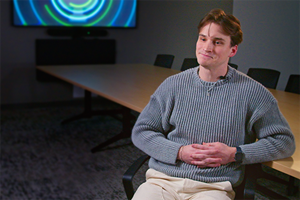
“The idea of AI being an existential threat to jobs is natural — it’s a feeling of the unknown,” he said. “But I think patients still value human connection, and I think that will still dominate medicine as a whole.”
In maybe the best endorsement for physicians, Lahade cautioned students against over-reliance on these rapidly evolving systems.
“Your responsibility is to keep the technology as a supplemental tool in your arsenal — not the main thing,” he said.
What comes next?
Although there hasn’t been AI instruction in the curriculum yet, both Gowan and Keele believe it will come.
“It’s new, it’s fresh,” Keele said. “There’s no reason why we would have had instruction on it yet, but that’s why we want to be on the front foot of that (with the SIG).”
Senior Associate Dean of Medical Student Education Anthony Shanks, MD, MS, MEd, who serves as a faculty mentor for the group, said the school is already working to ensure all graduates develop an understanding of artificial intelligence.
“We want IU School of Medicine graduates to all have the same baseline understanding of the benefits and the risks of this technology,” Shanks said. 
According to Shanks, elements of AI education are beginning to be embedded within health system science content in Phase 1, with plans to expand clinical exposure in later years. Fourth-year electives are also being developed to allow students to see how AI tools are applied within specific specialties.
Beyond foundational exposure, the school has proposed piloting an AI-focused scholarly concentration for students who want deeper training. The program would provide structured coursework over two years and culminate in a mentored research project applying AI in medical education.
Shanks emphasized that while today’s transformative technology is artificial intelligence, the larger goal is cultivating adaptability.
“AI will not take your job,” he said. “But your job may be taken by someone who knows how to leverage AI to their benefit.”
For students involved in the SIG, that mindset is precisely the point.
The next meeting of the AI in Medicine SIG is planned for March 17. The group plans to bring in more speakers and host skills workshops. Check out the AI in Medicine GroupMe and Instagram if you're interested in learning more.