The dark night explodes with the cheers of thousands of fans as they flood the streets of downtown Bloomington to celebrate Indiana University’s College Football National Championship victory. Suddenly, this festive scene turns chaotic — someone has fallen from the upstairs balcony of the pub, another person is overcome by smoke inhalation from a burning vehicle, and a loud noise causes the crowd to stampede.
It just so happens, there are 11 medical students on the scene who find themselves unexpectedly called to action. They must quickly identify people who need help, assess their injuries and call for ambulances.
This scene didn’t actually unfold on Bloomington’s Kirkwood Avenue on Jan. 19, but rather in the basement of the Informatics and Communications Technology Building on the IU Indianapolis campus, three months after that big celebratory night in Bloomington. The simulated mass casualty event was organized by Mitch Krathwohl, MD, as an immersive learning opportunity for first-year medical students in his Foundations of Clinical Practice course.
“I have never been in a situation like this before,” said IU School of Medicine student Katelyn Davis, who served as the simulation’s medical team lead. “It was stressful. We learned a lot about triaging and treating patients of different acuities.”
A massive collaborative effort
Krathwohl enlisted help from the IU Indianapolis Music Technology program and IU Bloomington’s Media School and theatre department to stage the event. Krathwohl also coordinated with IU Public Safety for event management and with Indianapolis EMS and Eskenazi Health to arrange ambulance transports to the hospital for student actors portraying patients.
 He wanted the simulation to feel as realistic — and chaotic — as possible.
“I think back to the first time I was in a code blue situation, and for the first 10 minutes, I was worthless, because you panic,” Krathwohl said. He wanted to give his students an opportunity to think through what they would do in an emergency — the goal of simulation. “They spend so much time sitting in lectures. I thought, ‘Let’s do something more creative.’”
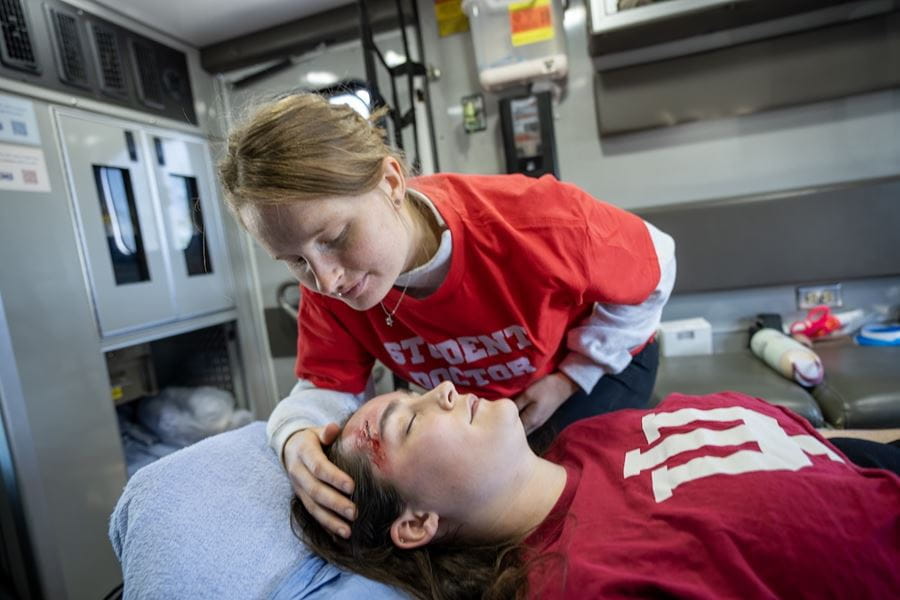
It was a massive undertaking to coordinate. Staging the scene involved pairing audio and video of the Kirkwood Avenue celebration with live actors who came with realistic looking wounds and backstories. Media School student Natalie Hernandez used artificial intelligence to create the movie-like scenes playing on three walls of the sensory sound room — a “black box” created for immersive experiences produced by the Music and Arts Technology program at Heron School of Art and Design. Robin Cox, DMA, associate professor of music technology, ran the sound room for the mass casualty simulation.
The project was a natural fit for Sarah Johnson, PhD, MFA, assistant professor of dramaturgy. She has an interest in applied theatre, which uses theatrical techniques outside of the traditional theatre setting to discover, learn and effect real-world change. Jackson Santi was quick to sign up to play a patient — a role relevant to both his major in community health and minor in theatre.
The simulation gave Johnson’s theatre students experience as “standardized patients,” a gig actors can consider when they are between shows. Using live actors adds a depth of realism to simulation training that can’t be achieved with manikins.
Sarah Finke, a mental health clinician with the Department of Mental Health Service at the IU School of Medicine, helped prepare medical students for the intense sensory experience. She’s been involved with several simulations through GJS Security, which provides hostile environment and first aid training for journalists and other civilians going into high-risk environments.
Finke showed the medical students how breathing and grounding practices can help them think more clearly in a stressful situation. One student actor played the role of an uninjured bystander who continually got in the way, demanding the doctors do more to help a friend who was having difficulty breathing. Finke suggested the medical team could give those kinds of bystanders a “job” like keeping their friend talking or applying pressure to a wound. “It gives them a place to focus their nervous energy,” she explained.
The medical students also received helpful tips from Indianapolis EMS Planning Section Chief Andrew Bowes and Special Events Lt. Laura Herring, who were onsite for the event and provided ambulances to take the student doctors and their patients to the Emergency Department at Sidney & Lois Eskenazi Hospital, where an ER doctor, nurses and staff were waiting to triage the patients of this mock mass casualty event.
Training together makes everyone better
Both Indianapolis EMS and Eskenazi Health regularly run simulations for their teams, but they had never done an event like this with the medical school.
“It is exciting for medical students to see the EMS, pre-hospital perspective and see what happens before, and how we get all these people to the hospital,” Herring said.
 Eskenazi had 20 staff involved in the simulation, including the Disaster Committee team lead who plans drills for the health system. As ambulances arrived in the bay, student doctors relayed their assessment to the waiting triage nurse who then administered a red, yellow or green wristband to indicate the medical urgency of each patient. The one who broke a femur after falling off the pub balcony needed to be quickly taken to surgery.
“It’s another opportunity for our staff to drill and an opportunity for us to collaborate with IU to improve our practices,” said Anne Timmons, the emergency department manager at Eskenazi. “Every opportunity we have to get experience like this will make us better prepared.”
For first-year medical students, the experience was much more impactful than a day in the classroom.
“We came in not knowing what to expect,” said IU medical student Shalini Tallamraju. “Having to think on our feet — that’s something that’s not taught in a classroom.”