Indiana University School of Medicine is one school with nine campuses and one mission: to advance health in the state of Indiana and beyond by promoting innovation and excellence in education, research and patient care.
That’s the message Dean Jay L. Hess, MD, PhD, MHSA, opened with during his last All School Meeting before he ends his tenure in July. He gave a retrospective update on the school’s notable progress during the Spring 2026 All School Meeting, held in the Medical Education and Research Building on April 16.
Hess joined IU as dean of the medical school and executive vice president for university clinical affairs in 2013.
“There’s a certain vibe about the School of Medicine and its people. This is a place that’s about collaboration and not about ego — it’s about getting things done,” Hess said. “That’s what brought me here.”
During his tenure, IU School of Medicine has made recruiting talented leaders a top priority, operating under the philosophy: “Recruit like your life depends on it.” The school recruited 26 new chairs, eight executive associate deans and many other leaders. Several came from top academic medicine centers, including Cleveland Clinic, Duke University, Johns Hopkins University, Vanderbilt University and several others, along with leaders rising from within IU.
“These leaders have brought intellectual diversity,” Hess said, “bringing new ideas and challenging assumptions.”
Growing student opportunities
 IU School of Medicine has also invested in new medical education facilities throughout the state. Since 2013, the school has opened four buildings with the latest technology in West Lafayette, Evansville, Bloomington and most recently, the new Medical Education and Research Building in Indianapolis.
The school also standardized its curriculum, combining the best features of each campus’ previous curriculum to promote equity and excellence throughout the nine-campus system. At the same time, the school launched Scholarly Concentrations, a program which taps into the talent and expertise of faculty at each campus, allowing medical students to explore areas such as urban medicine, rural health, the business of medicine, ethics in medicine, and public health, to name a few. About 500 students participate in Scholarly Concentration programs, giving them the opportunity to work closely with faculty and explore their interests in medicine.
The school also added learning communities — groups of 10-12 students who share study, relaxation and kitchenette space, allowing them to interact with near-peers and learn from the classes ahead of them — while also engaging in professional identity formation with faculty mentors.
Focusing on the well-being of its learners, IU School of Medicine provides free, unlimited access to mental health services on all of its campuses. Today, one in three IU medical students takes advantage of these important services.
“I am proud of the way we have destigmatized seeking care,” Hess said.
Mentoring and advising services have also been improved, and over 200 new scholarships have been established, allowing more than 80% of IU School of Medicine students to receive some sort of scholarship funding.
The collective result of these enhancements to the student learning environment is evident in medical student performance. IU School of Medicine’s pass rate on the U.S. medical licensing exam series surpasses the national average. Additionally, IU students report 93% overall satisfaction with their medical education — two points above the national average.
 In the Class of 2026, 97% of students were placed into residency programs following Match Day; 115 of those students will stay in Indiana for their training. Impressively, Hess noted, residency program directors surveyed by the AAMC said 98% of IU School of Medicine graduates met or exceeded expectations during their first year of residency.
As Indiana faces a shortage of physicians, particularly in rural areas, IU School of Medicine is addressing this in several ways. Class sizes have increased by 30% and undergraduate students from rural parts of the state are being recruited for a unique rural medicine track based at IU School of Medicine—Terre Haute.
Over the last decade, the number of medical students training at one of the school’s eight regional campuses has grown from about 20% to 40% of the total medical student population. That number is expected to increase in the years ahead, Hess said.
Still, Indiana does not have enough residency and fellowship programs to train new doctors. To address this shortage, IU School of Medicine has partnered with health systems across the state to increase residency positions by 25% in areas of high demand. IU School of Medicine—Bloomington has opened two new programs and will welcome its first groups of internal medicine and emergency medicine residents in July. A new Family Medicine Residency is planned to launch at the Northwest-Gary campus.
Launching a successful research strategy
The school’s strategy in research has been intentional: identify and invest in areas where IU can be a national leader. That means looking for synergies in education, research and patient care to align the most pressing public health needs in Indiana with opportunities for grant funding and philanthropy, then pairing that with areas of considerable faculty expertise. A good example of this is the Neuroscience Institute and the school’s growing expertise in Alzheimer’s research and dementia care, Hess said.
 The $120 million Precision Health Initiative identified top areas of focus: multiple myeloma, triple negative breast cancer, pediatric sarcoma, gestational diabetes and Alzheimer’s disease. To help facilitate and accelerate this work, the school made technology investments in areas such as genomic medicine; cell, gene and immune therapy; chemical biology and data science.
IU School of Medicine also has opened several new centers and institutes with philanthropic support, including the Vera Bradley Center for Breast Cancer Research, Indiana Center for Musculoskeletal Health, Brown Center for Immunotherapy and the newly established Tobias Lechleiter Institute for Clinical Innovation. Working with industry partners, Hess said he foresees the Tobias Lechleiter Institute becoming one of the top clinical trial sites in the nation.
Highlighting the school’s excellence in cancer research, the IU Melvin and Bren Simon Cancer Center received “comprehensive” status from the National Cancer Institute, becoming one of only 58 such centers in the U.S. — and the only comprehensive cancer center in Indiana.
With growing research programs comes a need for space. Since 2013, the school’s total research space has nearly tripled from 246,544 to 711,206 square feet. In Indianapolis, IU School of Medicine has expanded research facilities through the Neuroscience Research Building and the new research tower atop the Medical Education and Research Building. More space is yet needed, Hess said.
Research funding has grown, too. Since 2015, IU School of Medicine has more than doubled its grant funding, logging about $314.4 million in NIH funding and $547.7 million in total funding in 2025. Those increases have elevated IU’s national ranking from 42nd to 32nd among all U.S. medical schools and 15th among public medical schools, according to the Blue Ridge Institute for Medical Research.
Collaborative excellence in clinical care
When Hess arrived at IU in 2013, the health system landscape included more than 80 for-profit physicians’ groups statewide. The recent launch of a unified medical group — IU Health Medical Group — leverages the combined strengths of IU Health and IU School of Medicine to deliver the best patient care on a larger scale across the state, Hess said. The unified group provides statewide access to clinical trial enrollment, expands clinical placements for students and residents, and emphasizes shared responsibility for the academic mission across the health system.

“That’s a tremendous competitive advantage for us and will help us grow residencies and recruit,” Hess said. “We’re getting on the EPIC platform; we’re going to have a new hospital — we have a lot going for us.”
IU Health opened its new Bloomington hospital five years ago next to the new medical education building at IU School of Medicine—Bloomington. Now IU Health is building an 865-bed hospital in Indianapolis across from the school’s Medical Education and Research Building. The health system is also building a 140-bed hospital in Fort Wayne.
Several clinical programs have gained national distinction, including Riley Hospital for Children at IU Health, ranked No. 1 in Indiana and No. 3 in the Midwest for pediatric hospitals in 2025-26. Led by D. Wade Clapp, MD, chair of the Department of Pediatrics and physician-in-chief for Riley, the hospital achieved rankings in all 11 of its pediatric specialties, with three programs in the top 10 nationally.
IU School of Medicine is saving lives in Indiana — and beyond. During the COVID-19 pandemic, 517 medical students were trained in vaccine administration, delivering over 15,000 doses across all nine of the school’s regional campuses.
“I am proud of the way that IU pulled together during the pandemic,” Hess said. “One of the highlights for me was traveling around the state with groups of medical students and administering COVID vaccinations.”
Another collaborative effort is now underway to save lives by preventing lung cancer deaths. With the support of a generous gift from the Tom and Julie Wood Family Foundation and in collaboration with IU Health, a new 40-foot mobile lung screening unit has been deployed. Equipped with a CT scanner, the mobile unit is now screening more than 2,000 high-risk Hoosiers each year, including long-time smokers and firefighters. The program is led by Nasser Hanna, MD, and the IU Simon Comprehensive Cancer Center.
Reaching beyond borders, IU School of Medicine founded and leads the Academic Model Providing Access to Healthcare, known as AMPATH, an initiative in Kenya involving partnership between IU and Moi University, Moi Teaching and Referral Hospital, and the AMPATH Consortium of universities worldwide. Virtually all major IU School of Medicine departments and many sub-specialty divisions partner with AMPATH. This successful model is now being implemented in other countries through the AMPATH Global Network.
Philanthropy is a significant source of funding for many of the school’s initiatives to advance health in the state of Indiana and beyond. Since 2015, IU School of Medicine endowment grew from $643 million to over $1.2 billion in 2025.

Interim dean announced
Hess will step down as dean in July after nearly 13 years leading the IU School of Medicine. Michael Feldman, MD, PhD, has been named interim dean while a national search for the school’s next dean continues. Feldman is chair of the Department of Pathology and Laboratory Medicine and was previously Hess’ colleague at the University of Pennsylvania.
“He’s very collaborative, a good listener and thoughtful,” said Hess, who recruited Feldman to IU three years ago.
Faculty recognized for excellence in teaching
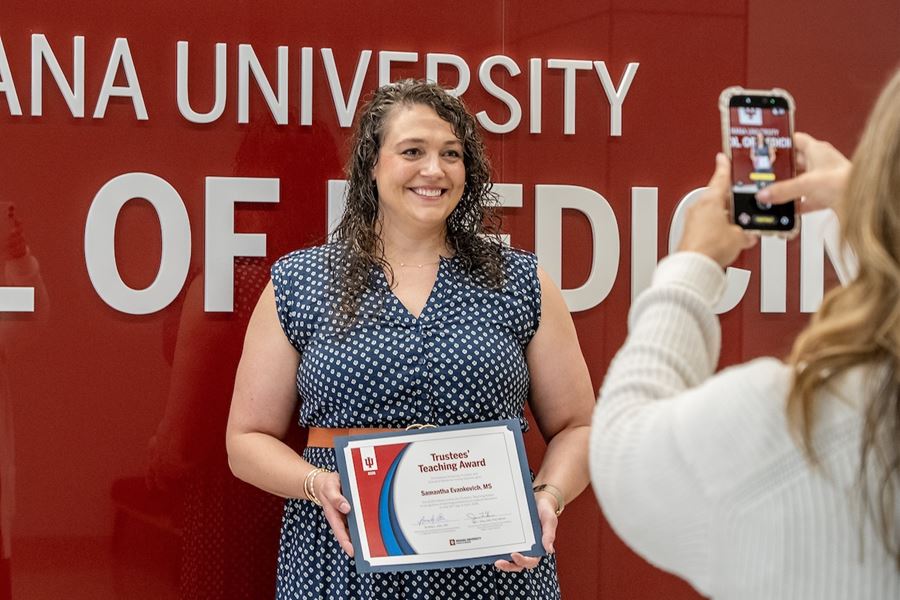
Results of the 2026-27 faculty elections were also announced at the Spring All School Meeting, and outstanding educators were recognized as recipients of the 2026 Trustees’ Teaching Awards.
See a list of all Trustees’ Teaching Award winners by department, and view Faculty Steering Committee members on the Faculty Affairs and Professional Development website. Erik Imel, MD, was announced as president-elect, and Margaret McNulty, PhD, as secretary-elect.
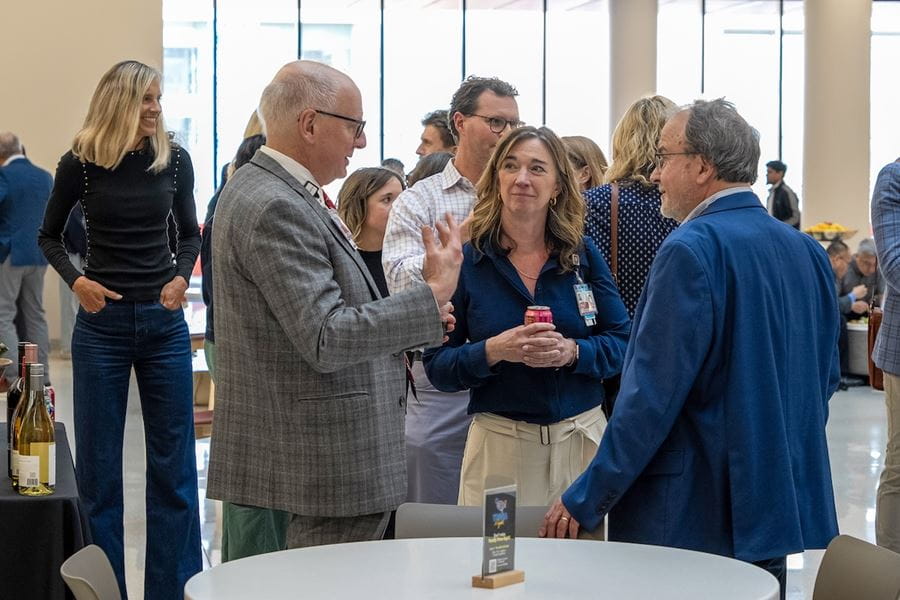
After the meeting closed, attendees had the opportunity to greet Hess and mingle while enjoying food and beverages.