From One Surgeon to Stronger Systems: How AMPATH and Donors Expand Surgical Care in Kenya

Matthew Harris Jan 07, 2026
GROWING UP, Jason Axt loved to use his hands.
He learned to tinker under the hood of a car to help his father. Later, he taught himself how to patch plumbing. And since the moment he entered health care, starting as a nurse and later as an EMT, Axt's innate understanding of how pieces should interlock has been an asset.
Today, those same deft hands serve him well as the surgery in-country leader for AMPATH at Moi Teaching and Referral Hospital (MTRH) and Moi University in western Kenya. On any given day, Axt, MD, a pediatric surgeon, and his team may repair a child's congenital malformation, stabilize a newborn struggling to breathe or teach a resident how to perform a life-saving procedure.
"Quite honestly, a lot of surgery is plumbing," said Axt, who joined AMPATH in November 2024. "It's the same principle: find the problem, restore the flow and fix it."
Behind every surgery, training session and research breakthrough in Eldoret stands a network of donors who make it possible. Through AMPATH’s model, gifts go far beyond immediate needs. Funding for one resident can have a ripple effect on thousands of patients. A small grant can build a referral network that saves the lives of dozens of newborns each year.
“A dollar given here doesn’t just save one life,” Axt explains. “It strengthens systems. It trains people. It multiplies.”
Axt’s role is also supported by generous donors who support the Department of Surgery at Indiana University School of Medicine. He’s an assistant professor of pediatric surgery and ambassador for the department. This fall, Axt spent a month in Indianapolis with colleagues and trainees.
“That time is so important,” Axt said. “You can work hard to build connections, but it’s so much easier when you’re working alongside peers and creating those relationships that can help us exchange ideas to help patients here and in Kenya.”
It also demands a mentality to scale up solutions beyond the operating room. In his role, Axt, along with his IU and Kenyan colleagues, is building a quality and reliable health system — one patient, one trainee and one relationship at a time.
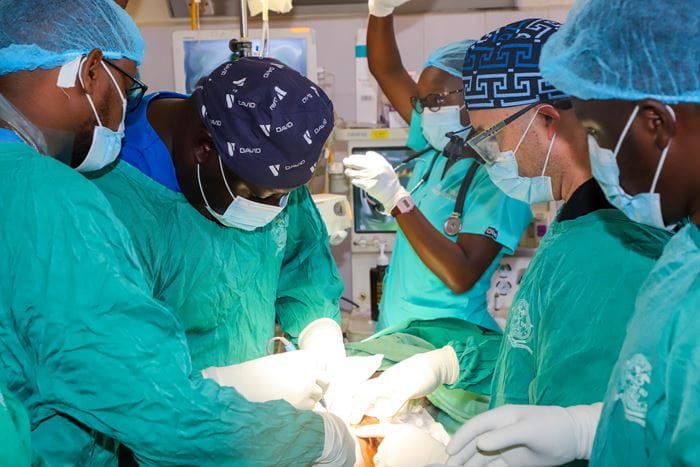
"It's about one person connecting with another, and then linking those individual bonds under the umbrella of institutions that make real, systemic change,” Axt said. “That's what AMPATH allows us to do."
Axt's road to AMPATH, a network of academic health centers first formed by Moi University and Indiana University more than 30 years ago, embodies its model: a partnership where education, research and clinical care blend through trust and collaboration.
Before becoming a surgeon, Axt worked as a paramedic and a nurse, funding his education in a stepwise progression to avoid debt. That cost-conscious approach did more than make his medical education at Northeast Ohio Medical College affordable. "If I'd had massive loans, I couldn't have done this," he recalled. "I always knew I wanted to use my skills where they were needed most."
Pursuing that ambition led to a decade of practicing and teaching at small, faith-based hospitals in Cameroon and eastern Kenya. Yet Axt and his family found themselves ready for a new challenge. When the opportunity to join AMPATH arose, the draw was obvious. It offered academic rigor, the opportunity to care for diverse patient populations and ample opportunities for teaching and research that could influence how health care is delivered across a national system.
His daily work unfolds in MTRH’s pediatric wards at Shoe4Africa Children's Hospital, a 250-bed facility that opened in 2015 as the first public children's hospital in eastern Africa. Its remit is to serve a footprint that encompasses more than 24 million people. It's an enormous scale, but one that offers promise alongside its complexities.
Inside the hospital's pair of operating rooms, Axt and surgical teams handle common childhood hernias all the way up to anomalies like anorectal malformations or Hirschsprung's disease. "We're the only referral center for a huge population," Axt noted. "These cases come to us in numbers you'd rarely see in the United States."
Meeting that demand requires creativity and endurance. Modern equipment can be scarce. If it breaks, replacement parts can be slow to arrive. Even donated laparoscopic cameras or scopes — vital tools for non-invasive procedures — can break down in the demanding conditions.
Financial hurdles are also a reality for patients and families. While Kenya has launched a national health insurance program, the rollout and implementation have been difficult. In the face of those challenges, Kenyan communities come together to help neighbors access care. "It's a reminder that generosity might look different in different places, but is needed everywhere," Axt said.
What sustains Axt is knowing he can honor the resilience of those communities by training more surgeons and collaborating on research that removes barriers.
Not long after arriving in Eldoret, Axt began noticing a heartbreaking trend. Newborns with congenital anomalies were reaching his team from regional hospitals already fighting for their lives. Many had been misdiagnosed or transferred too late.
Partnering with Dr. Peter Saula, Moi’s head of pediatric surgery, Axt helped launch a referral network through training and shared protocols. The early results were promising. A study conducted by Saula showed mortality rates among infants transferred from institutions in the network decreased by 25%. “It’s humbling,” Axt says. “This isn’t high-tech medicine. It’s better organization, communication and compassion — a low-cost intervention that saves lives.”
Axt is also pursuing practical research that blends innovation with common sense. They include:
- Adapting Indiana University's infection-prevention bundles to reduce surgical site infections
- Studying whether children can safely drink water before surgery rather than endure prolonged fasting
- Testing early-feeding protocols to help young patients recover more quickly in hospitals without IV nutrition
“I like research questions that have immediate clinical impact,” Axt said. “Things that make care better today, not ten years from now.”
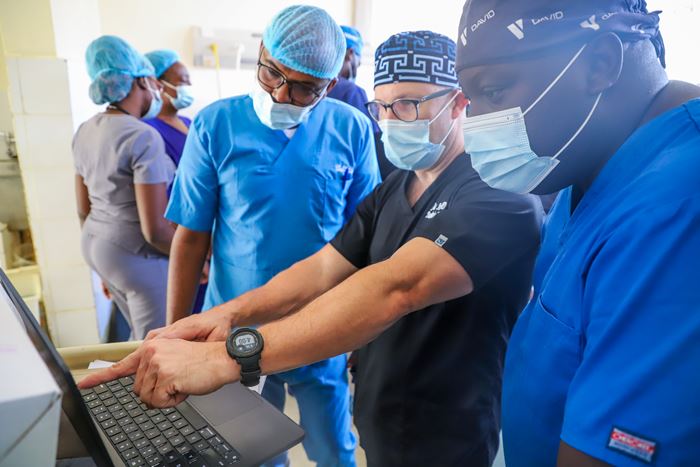
His long-term impact as AMPATH’s surgery in-country lead is training future surgeons. It’s not a side duty that Axt squeezes in when time allows. Teaching has always been a core component of his work and AMPATH’s mission. Every day, he’s surrounded by young physicians who scrub in eager to learn, assist and eventually lead.
“The most durable impact I can have,” Axt said, “is through the trainees I leave behind.”
Axt contributes to five surgical training programs spanning specialties such as general, pediatric and orthopedic surgery. Unlike the decade-long pathway in the U.S., programs in Kenya compress pediatric surgical training into five years, a structure designed to produce surgeons capable of handling a high volume of patients in communities where they’re needed most.
The learning curve is steep, but many residents and trainees arrive having already performed C-sections, repaired hernias and drained abscesses. Like their mentor, they know how to use their hands. What they need is guidance for surgical planning and decisions under the lights in an OR.
Focusing on reasoning over technology is a necessity. With limited access to imaging and equipment, the surgeons Axt teaches must develop a keen understanding of anatomy and a sense of improvisation. The impact is also undeniable.
“When they go back to their communities, they’ll save thousands of lives over their careers,” he said. “That’s the legacy we’re building.”
Donor support also gives AMPATH’s team the flexibility to innovate quickly and sustainably — testing new ideas, refining care and empowering Kenyan surgeons to lead. “Every gift becomes part of a story that keeps unfolding,” he says. “That’s what makes this work matter.”