IU partners with industry to advance innovative therapies through clinical trials benefitting people in Indiana and beyond
As a musician, Elijah Crysell pulls off the beanie look well. But often, it’s less an artistic choice and more a covering to keep curious eyes at bay.
Born with a good head of dark hair, Crysell, an Indiana University nursing student, keeps it long and styles it to hide the spots where hair won’t grow. He has been living with alopecia areata, an autoimmune disorder causing hair loss, since middle school.
“I wasn’t bullied, but I was stared at a lot,” he said. “I could feel eyes on me.”
Treatment with steroid injections and prescription shampoo didn’t help. It was just something he had to live with. Until now.
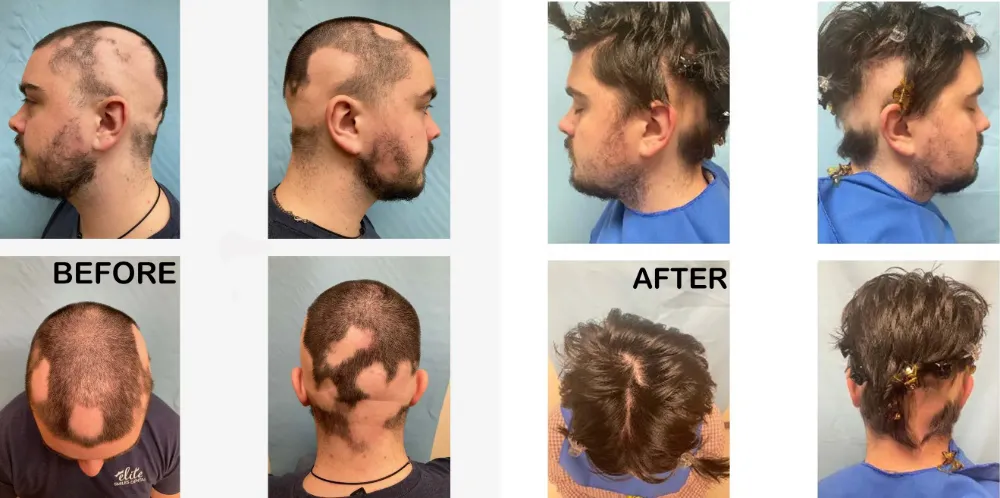
As a participant in a national clinical trial administered through the IU School of Medicine, Crysell received treatment with rezpegaldesleukin (Rezpeg). Through site injections of this novel biologic drug, Crysell not only stopped losing hair but also saw new hair growth — something he never achieved on other treatments.
“There was noticeable hair growth between appointments,” he said. “It grew starting from front to back. By the end of the trial, the top part was fully in, and the sides were coming in. To have no hair falling out, and to have hair growing in the spots was a pretty big relief.”
The science: How a novel biologic drug stimulates hair growth
Alopecia areata is a disease where a person’s own immune system attacks hair follicles through the formation of pathogenic T lymphocytes. Rezpegaldesleukin, developed by Nektar Therapeutics, is a biologic therapy that works by addressing this underlying immune system imbalance in people with alopecia areata and other autoimmune and inflammatory conditions.
Other recently approved drugs for alopecia, including Eli Lilly’s Olumiant (baricitinib), are in a class known as JAK inhibitors, which work by suppressing inflammatory immune activity. Rezpeg works differently, aiming to stimulate the immune system instead. It does this by targeting the interleukin-2 receptor complex in the body to stimulate production of immune cells known as regulatory T cells, or T-regs.
Essentially, it repairs the immune system from within by stimulating the body’s natural “brakes” on immune response.
The results: Regaining hair and confidence
To be eligible for the clinical trial, patients needed to have 50% to 100% hair loss on their scalp. After six months of treatment, participants saw an average gain of about 30% more hair. Those who stayed on the drug for a year experienced even more growth.
“Some of them actually still continued to grow hair, even after they were off treatment,” noted David Rosmarin, MD, chair of the Department of Dermatology and the Kampen-Norins Scholar in Dermatology at the IU School of Medicine. He recently presented results of the Phase 2b REZOLVE-AA trial at the European Academy of Dermatology and Venereology Congress 2026 in Vienna, Austria.
Rezpeg is now entering Phase 3 clinical trials for treating both alopecia areata and atopic dermatitis, a form of eczema that causes dry, itchy patches of skin.
 As an IU Indianapolis student, Crysell was eager to try this promising new therapy that was available right on campus — so close he could walk to his appointments at IU Health University Hospital, where he received Rezpeg injections every two weeks for six months.
“I didn’t expect it to work as quickly as it did,” said Crysell.
By the end of the trial, over 90% of his scalp was covered by hair. He started losing some of those gains shortly after stopping treatment, so he decided to go on an oral JAK inhibitor. That halted the hair loss but is not helping him grow new hair. If Rezpeg becomes FDA approved, he would switch back.
“It’s like a breath of fresh air to not worry about the spots getting bigger,” Crysell said.
Alopecia can affect not only the scalp but also eyebrows, eyelashes and beards.
“When people don’t have hair, they don’t feel confident,” Rosmarin said. “It can affect their ability to have relationships. Even when they are at work or school, they may be thinking about their hair rather than focusing on things that are important to them. Our goal is to help people, so it is not as much a factor in their quality of life.”
Most of the the study’s 92 participants who were treated with Rezpeg saw new hair growth.
“Enticingly, we saw that whether people have had the disease for less than four years or their current episode is more than four years, similar percentages of patients re-grew their hair,” Rosmarin noted.
The drug also demonstrated excellent safety. The most common side effect was mild: redness at the injection site.
“This is likely going to be the first biologic that gets FDA approved, assuming a successful Phase 3 trial for alopecia areata,” Rosmarin said.
Set to begin in January 2027, Phase 3 will engage a larger number of patients, including adolescents.
The impact: Beyond alopecia
A surprising result in the atopic dermatitis study was that patients with a history of asthma also reported improvement in their asthma symptoms while taking Rezpeg. Researchers think the drug could help reset the body’s immune system for people with other autoimmune diseases like rheumatoid arthritis, multiple sclerosis and Type 1 diabetes.
“If confirmed in larger controlled studies, these findings could provide important evidence that restoring immune regulation, rather than continuously suppressing inflammatory signaling, may offer a new approach to treating autoimmune and inflammatory diseases,” said Sohail Chaudhry, MD, PhD, vice president of clinical development for Nektar Therapeutics.
The team: IU’s strength as a partner for clinical trials
In recent years, IU School of Medicine has focused on growing its infrastructure for clinical trials — fulfilling its goal to improve health and wellness for people in Indiana and beyond. IU currently has 1,800 active clinical studies with over 196,000 participants and was awarded $548 million in research grants in 2025 to address today’s greatest health challenges.
 A successful clinical trialist from Tufts University in Boston, Rosmarin was recruited to IU in 2022 to lead the Department of Dermatology. At Tufts, he led trials for the first FDA-approved treatment for vitiligo, an autoimmune skin condition that results in light-colored patches on the skin. His team was also involved in testing the first biologic drug approved by the FDA for bullous pemphigoid, an autoimmune disease that causes large blisters and severe itching.
Nektar sought Rosmarin’s expertise due to his “strong track record of advancing novel dermatologic therapies through development,” Chaudhry said. “His combination of scientific leadership and hands-on experience treating patients with challenging inflammatory diseases makes his perspective especially valuable as Rezpeg advances into late-stage development.”
It’s important for IU to be a national leader in clinical trials, not only to advance innovative medical science globally but also to provide access for Hoosiers who are living daily with debilitating diseases, said Rosmarin.
“Clinical trials are one avenue to provide the latest and best drugs to our community and people in Indiana,” he said.
Rosmarin will continue playing a key role in the next phase of clinical studies for Rezpeg, which has been fast-tracked by the FDA.
“Given the important contributions by Dr. David Rosmarin and IU to the program to date, we hope IU will continue to be a valued scientific and clinical partner as Rezpeg advances, including through clinical-study participation, scientific interpretation of the findings, and continued engagement with the broader dermatology community,” Chaudhry said.