Gary Landreth, PhD, first heard about the rising field of neuroscience while majoring in chemistry and biochemistry at the University of Kansas in the early 1970s.
"Nobody really knew what it was," said Landreth, who at the time was an undergraduate researcher working in a laboratory studying nerve regeneration, "but it was pretty clear that it was the future and that some of the most interesting and complicated questions would be asked about nervous system function. To be there at the inception of a major scientific movement was scary and exciting at the same time because we were in unchartered waters."
Landreth later became the first student to graduate with a PhD from the Neuroscience Graduate Program at the University of Michigan. He's now spent his entire career in the field, most notably investigating Alzheimer's disease — specifically how genetic risks factor influence disease pathogenesis.
After nearly 50 years leading neuroscience research investigations and education programs, Landreth, the Martin Professor of Alzheimer's Research and a professor of anatomy, cell biology and physiology at the Indiana University School of Medicine, is planning to retire.
"It's been a great ride," Landreth said. "I do think, however, it's time for me and people of my generation to step back and let younger people take over. I'm incredibly grateful to be able to work with a very talented group of trainees over the years."
Landreth’s colleagues and past trainees have organized a research symposium in his honor, “Beyond the Bench: Honoring Dr. Gary Landreth’s Contributions to Science and Mentorship,” on Oct. 9 at the IU School of Medicine Medical Education and Research Building.
The day-long event will offer opportunities to share stories, revisit research milestones and honor the legacy of mentorship and collaboration that Landreth fostered throughout the years. Michael Heneka, MD, professor of neurology and neuroscience at the University of Luxembourg and a longtime collaborator of Landreth’s, will be the keynote speaker.
The early days of neuroscience
 As an 18-year-old in Wichita, Kansas, at the height of the Vietnam War, Landreth started summer classes at Wichita State University a week after graduating high school. His plan was to work full-time for two years to save enough money so he could go to the University of Kansas in Lawrence to study science and not have to work during his final years of college.
"It proved to be an effective strategy," Landreth said, "but I got sucked into research in a lab and haven’t escaped yet."
After graduating from Kansas with degrees in chemistry and biochemistry, Landreth joined the first class of the neuroscience graduate program at the University of Michigan. He and his high school sweetheart, Leslie, also married before their move to Ann Arbor.
"All in two weeks; I don't recommend that," Landreth said, with a laugh.
At the time, there were only a handful of neuroscience departments in the country. Landreth worked in a laboratory led by Bernard Agranoff, MD, a prominent leader in the field who was among the first scientists to show that memory formation requires protein synthesis. Landreth also spent a year studying at the National Institute of Medical Research in London.
"And so, I spent four years basically working on animal models of neurological disease. And it was lots of fun," he said. "We knew we were doing something important. We just couldn't articulate or capitalize on it. The scientific world was changing rather dramatically."
After obtaining his PhD degree at the University of Michigan in 1977, Landreth worked as postdoctoral researcher at Stanford University with Eric Shooter, PhD, the founding chair of the Department of Neurobiology at the medical school.
"Again, it was a brand-new department, and he hired some of the smartest people I've ever met," Landreth said.
Following his postdoctoral training at Stanford, Landreth joined the faculty at the Medical University of South Carolina in 1980. He later moved to Case Western Reserve University in Cleveland and directed the Alzheimer Research Laboratory for 27 years, from 1989 until 2016.
Launching a new chapter at Stark

Landreth had planned to retire 10 years ago.
But he changed his mind when Bruce Lamb, PhD, executive director of Stark Neurosciences Research Institute, recruited Landreth to join the institute in 2017. Lamb, who had previously worked at the Cleveland Clinic, a healthcare and academic partner of Case Western, came to the IU School of Medicine in 2016 to lead the neurosciences institute.
Lamb first met Landreth in 1996 when Lamb joined the Department of Genetics at Case Western. Landreth was a professor in the Department of Neuroscience, and they regularly interacted during meetings of the school’s Alzheimer’s Disease Research Center and at happy hour events for the Departments of Genetics and Neuroscience.
Lamb and Landreth continued to collaborate even after Lamb had moved his laboratory to the Cleveland Clinic, just a few blocks away from Case Western. They worked together on research projects, co-authored numerous publications and co-mentored students.
"When I decided to move to IU, one of the first things I did was reach out to Gary and ask him to come visit Stark without any commitments. I knew that if I was able to recruit him, his stellar reputation would enable me to recruit additional researchers," Lamb said. "The education program at Stark needed a substantial overhaul to make it competitive at the national level. Gary had previously run the education program at Case Western, and it was recognized as one of the top programs in the country."
Landreth, now the executive associate director of education at Stark, was tasked with restructuring the institute’s Medical Neuroscience Graduate Program. He has helped recruit graduate students, created a new curriculum, expanded offerings for MD-PhD trainees and instilled a healthy and support environment for collaboration and productivity.
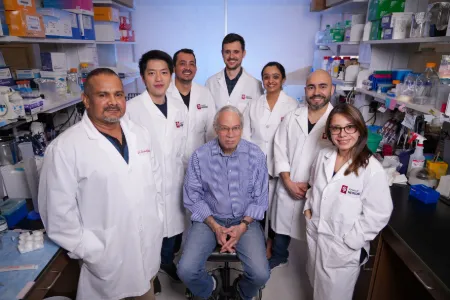
The growth of the graduate program and institute stems from Lamb, Landreth said. Since 2016, Stark has amassed nearly $680 million in National Institutes of Health funding, recruited dozens of neuroscience experts from across the country and graduated 69 PhD and MD-PhD trainees.
"IU is one of the most exciting places in the country right now to work on neurodegenerative diseases, and Bruce made that possible," Landreth said. "He’s just a true force of character and scientific integrity — and he's just a really smart guy who has been an absolute pleasure. One of the highlights of my career was to be chosen to come work in this environment for the decade that I did. He's been a guiding light."
Rene Baugh, who worked with Landreth as the assistant director of education at Stark, joined the institute in 2019 and said she saw firsthand Landreth transform the Medical Neuroscience Graduate Program into a highly respected training program. The program consistently maintains more than 40 graduate students each year, and its alumni have placed at universities and companies across the country.
Landreth also serves as a co-principal investigator of the Training Grant on Alzheimer's Disease and Alzheimer's Disease-Related Dementias, a National Institute on Aging-funded T32 grant program that supports the work of postdoctoral researchers and predoctoral students.
"Gary is not afraid to advocate for those he believes in and always prioritizes what is best for students and the program," Baugh said. "He also demonstrated the importance of strategic recruitment by ensuring that top students were presented to the admissions committee, a key factor in the program’s growth and success."
‘I was struck by how much he cared’

Landreth's lab has historically had a "waiting line" to join, although he's not sure there's a clear answer why, he admits. He has graduated 30 PhD students over his career.
"You know, it really wasn't me. It was all these really smart trainees I worked with," Landreth said. "My only contribution is I've been very fortunate that I've been able to identify an amazing source of talent."
"I put them onto a problem, provide some resources and then try to stay out of their way. I am just a cheerleader. The key? Trainees have to believe that you care about them and want them to succeed. As a mentor you need to provide insight and inspiration. The trainees have to feel supported, safe and scientifically competitive."
Miguel Moutinho, PharmD, PhD, connected with Landreth while searching for a postdoctoral position in 2016 after completing his PhD at the University of Lisbon in Portugal. He emailed Landreth asking about opportunities and later interviewed for a position in his lab, which was about to transition to the IU School of Medicine from Case Western at the start of 2017.
"Fortunately, he saw potential in me and believed I would be a good fit for his research group," said Moutinho, assistant professor of medical and molecular genetics. "That conversation marked the beginning of a mentorship that has had a profound impact on my career."
Moutinho, who worked as a postdoctoral researcher and an assistant research professor in Landreth's lab, now runs his own lab at Stark focused on the molecular and cellular mechanisms underlying Alzheimer's disease and related dementias.
"Gary had an exceptional ability to provide guidance at exactly the right moments, offering thoughtful feedback when it was most needed or when I sought his advice, while otherwise giving me the space to develop as an independent scientist," Moutinho said. "That balance of guidance and autonomy has profoundly shaped my own approach to mentoring."
 Andy Tsai, PhD, first met Landreth during the Indiana BioMedical Gateway Program (IBMG) orientation and poster session at the IU School of Medicine in 2017. Tsai had followed Landreth’s research for years and the potential to join his lab was one of the biggest reasons the first-generation student from rural Taiwan chose IU for his PhD training.
"At the time, everyone wanted to join Gary's lab," Tsai said. "I still remember walking into that poster session hoping that somehow I would have the opportunity to talk to him and train with him. From our very first conversation, I was struck by how much he cared, not just about science, but about people. He didn't simply ask about my research interests. He wanted to know my goals, my background, and the kind of scientist and person I hoped to become."
Tsai, who graduated with a PhD from the Medical Neuroscience Graduate Program in 2022, split his time between Landreth's lab and Lamb's lab studying Alzheimer's disease research. Tsai, now a postdoctoral researcher at Stanford – like Landreth was nearly 50 years ago — said he’s fortunate to have worked with Landreth, who has had an indelible impact on his career.
"Gary didn't just teach me how to become a scientist," Tsai said, "he gave me the confidence to believe that I could become one. More than anything, I hope to become the kind of scientist and mentor who makes Gary proud."