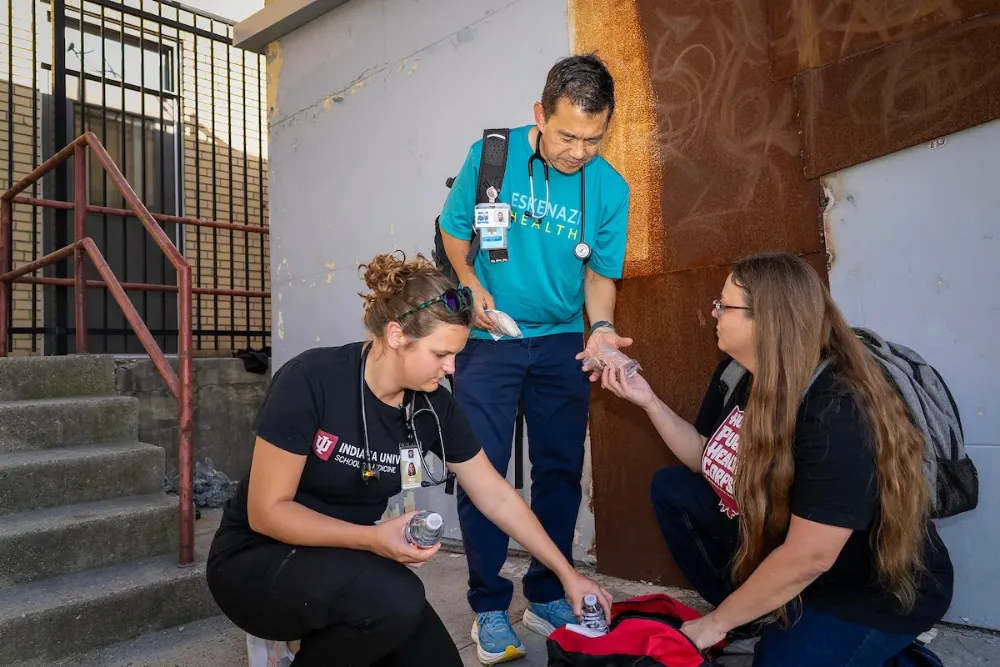
Mary Slaughter didn’t know what to expect as she walked alongside nurse practitioner Abby Wantz toward the encampment. They stopped at the entrance of a tent, and the owner graciously invited them in, eager to show Wantz a painful foot wound.
What Slaughter remembers most about that first day volunteering with Indy HealthNet is how grateful people living in the encampment were for the house call.
“That was just super powerful to be welcomed into their space and see how they are living,” said Slaughter, a fourth-year medical student at the Indiana University School of Medicine. She’s co-founder of an emerging Street Medicine program that has grown from occasional outreaches to a structured elective with branches extending across the state.
One of the highest compliments that Slaughter has ever received didn’t come from a professor but rather from one of the “neighbors” living at a local encampment who told her that when she becomes a doctor, “You’ll be one of the good ones.”
It means a lot coming from someone in a population that is often distrusting of the healthcare system due to dehumanizing experiences.
“Just because someone is living outside doesn’t mean they’re anything less,” Slaughter said. “I’m really big on breaking down barriers to care, and if we need to go physically meet them where they are, whether that’s on the street or in an encampment, then I think that’s something we should do.”
During her medical school orientation three years ago, Slaughter fortuitously found herself in a small group led by Niki Messmore, MSEd, the school’s director for medical service learning. “I brought up this wacky idea I had about doing street medicine, and Mary got so excited,” Messmore recalled.
The two began that very day to plot out the path for what has become the Street Medicine program. It now includes nonprofit and health system partners throughout the state, all working together to expand local outreach efforts.
“It is important to expose medical students to the unhoused population in our community because there is a high likelihood that they will be interacting with someone experiencing homelessness at some point in their training or career,” said Wantz, medical co-lead of the HealthNet Homeless Initiative Program. “They need to know these patients deserve the same dignity and respect that a VIP receives.”
Building a street medicine network across Indiana
The Street Medicine elective launched in fall 2025, and other outreach efforts are happening through AmeriCorps at IU School of Medicine. More than 340 medical students have signed up for the newly formed Street Medicine Student Interest Group.
 Ira Means, MD, is the faculty physician leading the program with Messmore. An assistant professor of clinical medicine and pediatrics, Means has worked at the Eskenazi Health Pedigo Center, embedded at Horizon House — a nonprofit which offers comprehensive services to people experiencing homelessness — for 15 years. Now he’s taking healthcare into the streets.
“Essentially, it’s making a home visit and entering their domain,” explained Means. “You try to give them the best care you can, and some of that is logistically harder to do when someone is unhoused.”
Care plans need to work around challenges like lack of refrigeration, secure storage or regular meals, which can make it difficult to take prescribed medication consistently. There are also issues with follow-up care in a population that is often transient and lacks transportation or phone service.
“We’re starting to see some impacts that we’ve made,” reported Means. “I had a patient in heart failure who needed his medicines. We were able to get those to him and see that he’s not in heart failure now. We were also able to get a patient to the hospital for syphilis treatment, which may not have happened otherwise.”
As IU strengthens relationships with community partners in Indianapolis, outreach efforts are growing throughout the state. In Bloomington, a collaboration with HealthNet and IU Health Bloomington is reducing repeat ER visits from individuals experiencing homelessness. In Terre Haute, medical students are giving talks at local shelters on managing chronic health conditions, and they are working with Union Health to facilitate pop-up clinics providing vaccines, hygiene care and disease screenings in locations like libraries, churches and food pantries.
In South Bend, medical students are joining family medicine residents and faculty in partnership with New Day Intake Center to offer clinic services at Indiana’s only low-barrier homeless shelter, Motels4Now.
“We work specifically with folks who are chronically homeless, and the majority of patients have severe substance use disorders, psychotic illness or a history of significant brain injury,” said Kennedy Onuoha, the student hub leader for street medicine at IU School of Medicine—South Bend. “Many are very ill, but most have significant barriers to receiving quality medical care. One of these barriers is a history of absolutely terrible interactions with the healthcare system.

“A big part of street medicine is connecting with people on a human level and building relationships that help to restore trust in healthcare providers.”
Onuoha has seen life-threatening heart conditions, blood clots, wounds and infections diagnosed — and sometimes treated — on the street. While the goal is to connect these individuals with long-term primary care and emergency services, when needed, sometimes a person will refuse. So, they do what they can.
One man who was septic and barely able to move due to a severe bacterial infection was given oral antibiotics, which likely saved his life. A woman with leg pain indicative of a blood clot was convinced to go to the hospital after “lots of empathetic listening and motivational interviewing.” She experienced a pulmonary embolism as soon as she got there.
“She would have died right then if she was not in the ER,” Onuoha said. “There are so many stories like that. Multiple people have had their lives saved by street medicine.”
At the motel shelter, the street medicine team manages medications and fills daily pill boxes for people who would otherwise be unmedicated for serious medical and psychiatric illnesses. The team also helps schedule doctors’ appointments and even accompanies patients when requested.
“This is really important for some people because they get very anxious in medical settings and need an advocate,” Onuoha said. “It is helpful for both the provider and the patient because we can act like translators and help facilitate smooth communication.”
Assessing the need: What the numbers show about street medicine
According to the Coalition for Homeless Intervention and Prevention’s most recent Point-In-Time Count, an annual census of individuals experiencing homelessness in Indianapolis, there were 1,815 people sleeping in emergency shelters, transitional housing or places not meant for habitation on Jan. 22, 2025.
IU School of Medicine is partnering with Sanctuary Indy, a nonprofit addressing the homelessness crisis, on a grant to assess what this population’s health looks like. People enduring chronic homelessness frequently have complicated personal health profiles with intersecting mental illness, physical disabilities, substance use disorders and chronic diseases. Left untreated, this often leads to interactions with law enforcement and frequent ER visits.
Patrick Monahan, PhD, a professor of biostatistics and health data science at the IU School of Medicine, is leading a research study aimed at quantifying the extent of co-occurring health conditions among the unhoused population in Indianapolis. He and a team of medical students surveyed 180 people living in tent encampments and another 80 individuals living at extended stay motels.
 About 32% of both populations had major physical and mental health impairments, including severe mental illness or moderate-to-severe traumatic brain injury, making it difficult to live independently. Major barriers to obtaining housing included low income, job loss, criminal record, evictions, unreliable transportation, and mental and physical health impairments, Monahan said.
“A strength of the study is that we used academically rigorous, patient-reported health outcome surveys,” he noted. “Innovatively, some health scales have never before been collected from homeless populations, including a clever, four-item survey that assesses presence of psychosis more validly than asking participants if they have ever been told by a healthcare professional that they have schizophrenia or psychosis.”
These preliminary survey results underscore the role of street medicine in providing continuity of care for one of the most vulnerable populations.
“I think people make a lot of assumptions and stereotypes about people who are unhoused,” said Sapna Nakshatri, a student involved in the research through AmeriCorps. “Everyone deserves healthcare.”
Economic impacts to Indiana’s health systems
Every day, on every shift at the hospital emergency department, people show up for issues that could have been prevented with consistent primary healthcare.
“Those patients hold a soft spot in my heart,” said Analissa Cox, MD, an IU Health physician and assistant professor of emergency medicine practice at IU School of Medicine who is spearheading her department’s street and mobile medicine initiative. “They’re a great group of people; they’re just in tough situations.”
With most hospitals already short staffed, this creates additional strain on critical care services. The fast-paced ER environment isn’t the place to deal with complex health and social service needs. “Outside of the emergency department, time is not as restricted,” Cox said. “At encampments, we have more time to create that rapport and get to know their story and get to know who they are as a human and potentially provide better care for them overall.”
 As an emergency medicine resident at IU, Cox connected with Messmore and joined the growing street medicine initiative with sights on getting a mobile healthcare unit launched in Indianapolis in partnership with the Marion County Health Department. Her dream would to be to offer mental health care alongside medical management of chronic diseases, including a mobile pharmacy to administer medications daily to those who lack a safe place to store their prescription drugs.
An important goal of the initiative is to identify frequent ER visitors and connect them to a primary care provider for follow ups, whether that be through a mobile unit or at a free clinic in their area. A successful model already exists in Bloomington.
The emergency department at IU Health Bloomington Hospital has developed a system to refer unhoused individuals with heavy ER usage to HealthNet’s street medicine team for follow-up. As part of his AmeriCorps service, IU medical student Tommy McEvilly analyzed health system data to determine how often unhoused individuals visited the ER before and after becoming part of the program.
The intervention had a significant impact. Over the course of a year, HealthNet determined that follow-up care from its Homeless Initiative Program saved the health system about $730,000 and prevented 123 ER visits, representing a 17% reduction in ER visits per individual.
“Ideally, the program could work closely with the three emergency departments that probably serve the most homeless — Eskenazi, IU Health Methodist and Community East (hospitals in Indianapolis) — to have students who can work with street medicine teams to find the ‘frequent fliers’ and see them on the street or in shelters and, ultimately, reduce ER visits, which would result in hundreds of thousands of dollars in savings for the hospital systems,” said Wantz, of HealthNet.
Transferring medical learning from classroom to street
Cox calls community partners like HealthNet, Horizon House and Sanctuary Indy “the trusting bridge” between the medical school and the community’s unhoused population. Likewise, these community organizations welcome a growing number of helpers from IU School of Medicine who are passionate about the shared mission to improve healthcare for a marginalized group living in the shadows.
“It isn’t only important for our future doctors to see the physical needs of our vulnerable populations but to see the mental and emotional struggles, too,” said Stacie Jasorka, outreach coordinator at Sanctuary Indy. “The importance of listening and learning from our unhoused community isn’t something you can just learn from a textbook; you need to be out in the streets, seeing with your own eyes and hearing with your ears what is really going on.”
 As the newest class of medical students begins their journey at the IU School of Medicine this fall, part of their orientation experience included a service-learning project and discussion around the Common Read book selection: “Rough Sleepers” by Tracy Kidder. It tells the story of Jim O’Connell, MD, a Harvard Medical School graduate who was nearing the end of his residency at Massachusetts General Hospital when he decided to defer his fellowship training and spend a year helping improve healthcare for the city’s unhoused population. That year turned into O’Connell’s life calling and the creation of Boston Health Care for the Homeless.
The book explores strategies for building trust and caring for individuals suffering from trauma and complex health conditions. Messmore often uses its wisdom when debriefing with students in the Street Medicine program.
“The hope is that incoming students will have more insight, understanding and empathy for folks who are experiencing homelessness or other social challenges, and we hope to provide better patient care to them in the future,” Messmore said. “Of course, we hope that they’ll want to get involved in our service-learning efforts statewide, too.”
A previous Common Read selection, “Just Mercy” by Bryan Stevenson, dealt with inequities in the criminal justice system. “We did a pre- and post-survey asking, ‘Would you be comfortable treating a patient experiencing incarceration?’ And we definitely saw an increase in students’ comfort and empathy for incarcerated patient populations. So, we are hoping that something similar will happen with this book.”
Anyone in the IU School of Medicine community — faculty, student or staff — is welcome to read along and participate in book club discussions planned for later in the year.
For Slaughter, street medicine has helped define her career ambitions as she completes her final year of medical school. She aims to become an infectious disease doctor serving vulnerable populations across the world, as well as in her own backyard.
“I’m applying to internal medicine residencies right now, and a lot of them have a global health or local health focus with a dedicated street medicine program,” she said. “But if I go somewhere that doesn’t have one, I can just make it again.”