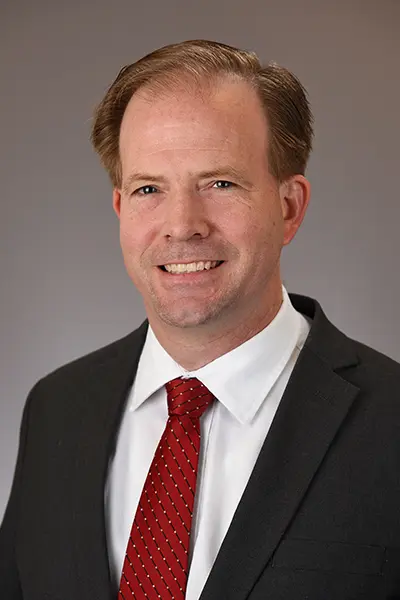
Brent Clayton, PhD
Associate Research Professor of Medicine
- wbclayto@iu.edu
- Address
-
TO 1038A
CPHR
IN
Indianapolis, IN
Bio
Dr. Brent Clayton is an Associate Research Professor of Medicine at the Indiana University School of Medicine and serves as the Medicinal Chemistry/Chemical Biology Core Leader for the IUSM/Purdue TREAT-AD Center. He earned a BS in Chemistry from Brigham Young University and a PhD in Organic Chemistry from The Pennsylvania State University. Before joining Indiana University in 2022, he held scientific and leadership positions in medicinal chemistry, drug discovery, and pharmaceutical manufacturing, including roles at the Purdue Institute for Drug Discovery, Evonik Industries, and Albany Molecular Research Inc (now Curia). His background spans synthetic organic chemistry, medicinal chemistry, project management, and multidisciplinary drug discovery, with current research focused on developing chemical tools and potential therapeutic leads for Alzheimer’s disease and related dementias.
Key Publications
Publications:
Giardina, S. F.; Culver, A.; Ahmed, C.; Mirescu, C.; Oblak, A. L.; Brosch, J.; Clayton, W. B.; Dage, J. L.; Lamb, B. T.; Richardson, T. I.; Small, D.; Palkowitz, A. D. From consortia discovery to biotech creation: An innovative approach to next-gen Alzheimer's drugs, Alzheimer’s Dement. 2026;22:e71165, https://doi.org/10.1002/alz.71165.
Jesudason, C. D.; Rangel-Barajas, C.; Beach, C. J.; Beck, D. E.; Caballero-Floran, I. H.; Clayton, W. B.; Da Silva, L.; David, J. C.; Doolen, S.; Faulkner, A. N.; Hamdani, A. K.; Huhe, H.; Huynh, K.; Imhoff, R. D.; Javens-Wolfe, J.; Mason, E. R.; Moussaif, M.; Singhal, K.; Soni, D. M.; van Buuren-Milne, M.; Williams, S.-P.; Angus, S. P.; Chu, S.; Dage, J. L.; Hipskind, P. A.; Johnson, T. S.; Kaddurah-Daouk, R.; Lamb, B. T.; Meikle, P. J.; Mesecar, A. D.; Palkowitz, A. D.; Quinney, S. K.; Sukoff Rizzo, S. J.; Oblak, A. L.; Richardson, T. I. Optimization and Characterization of SHIP1 Ligands for Cellular Target Engagement and Activity in Alzheimer’s Disease Models, Journal of Medicinal Chemistry 2026. https://doi.org/10.1021/acs.jmedchem.6c00010
Clayton, B.; Kulas, J. A.; Liu, J.; Walia, N.; Rangel-Barajas, C.; Johnson, T.; Zhang, J.; Huang, K.; Mesecar, A. D.; Dage, J. L.; Lamb, B. T.; Palkowitz, A. D.; Richardson, T. I. Evaluation of ASC as a Therapeutic Target for Alzheimer’s Disease, Alzheimer’s Dement. 2026;22:e71104, https://doi.org/10.1002/alz.71104.
Richardson, T. I.; Klein, R. C.; Huang, K.; Zhang, J.; Mesecar, A. D.; Dage, J. L.; Clayton, B.; Lamb, B. T.; Palkowitz, A. D. Next Generation Alzheimer’s Therapeutics: Target assessment and enablement at the Indiana University School of Medicine–Purdue University TREAT-AD Center, Alzheimer’s Dement. 2026;22:e70964, https://doi.org/10.1002/alz.70964.
Weerawarna, P.; Benitah, A.; Richardson, T. I.; Clayton, B.; Dage, J.; Huang, K.; Lamb, B.; Mesecar, A.; Palkowitz, A. IUSM-Purdue TREAT-AD Milestone 2 Target Enabling Package: LYN (LYN proto-oncogene, Src family tyrosine kinase). Zenodo (2025) https://doi.org/10.5281/zenodo.17545570.
Weerawarna, P. M.; Chu, S.; Clayton, B.; El Jordi, O.; Gu, X.; Mason, E.; Richardson, T. I.; Dage, J.; Huang, K.; Lamb, B.; Mesecar, A.; Palkowitz, A. IUSM-Purdue TREAT-AD Center Milestone 2 Target Enabling Package: NLRP3 (NLR family pyrin domain containing 3). Zenodo (2025) https://doi.org/10.5281/zenodo.17428459.
Johnson, T.; Peyton, M.; Meyer, G.; Walia, N.; Hensel, J.; Jadala, C.; Jury-Garfe, N.; Liu, J.; Beimfohr, C.; Sunil, C.; Brooks, S.; Huang, K.; Mesecar, A.; Dage, J.; Clayton, B.; Lamb, B.; Palkowitz, A.; Richardson, T. I.; Zhang, P.; McCabe, S. D.; Lasagna-Reeves, C. A.; Zhang, J. IUSM-Purdue TREAT-AD Center Milestone 1 Target Enabling Package Disrupted-in-Schizophrenia 1 (DISC1). Zenodo (2025) https://doi.org/10.5281/zenodo.17144980.
Clayton, B.; Lendy, E.; Liu, J.; Rangel-Barajas, C.; Johnson, T.; Delery, E.; Schulte, M.; Richardson, T. I.; Huang, K.; Mesecar, A.; Dage, J.; Lamb, B.; Palkowitz, A. IUSM-Purdue TREAT-AD Center Milestone 1 Target Enabling Package Solute Carrier Family 7 Member 11 (SLC7A11). Zenodo (2025) https://doi.org/10.5281/zenodo.16763168.
Clayton, B.; Liu, J.; Rangel-Barajas, C.; Walia, N.; Kulas, J.; Johnson, T.; Richardson, T. I. IUSM-Purdue TREAT-AD Center Milestone 1 Target Enabling Package Evaluation of Apoptosis-associated Speck-like Protein Containing a CARD (ASC) for Alzheimer’s Drug Discovery. Zenodo (2025) https://doi.org/10.5281/zenodo.15359408.
Visvanathan, R.; Utsuki, T; Beck, D. E.; Clayton, W. B.; Lendy, E.; Sun, K.; Liu, Y.; Hering, K. W.; Mesecar, A.; Zhang, Z.-Y.; Putt, K. S. A novel micellular fluorogenic substrate for quantitating the activity of 1-phosphatidylinositol 4,5-bisphosphate phosphodiesterase gamma (PLCγ) enzymes. PLoS ONE, 2024, 19(3): e0299541. https://doi.org/10.1371/journal.pone.0299541
Wallach, I.; Bernard, D.; Nguyen, K.; Ho, G.; Morrison, A.; Stecula, A.; Rosnik, A.; O’Sullivan, A. M.; Davtyan, A.; Samudio, B.; Thomas, B.; Worley, B.; Butler, B.; Laggner, C.; Thayer, D.; Moharreri, E.; Friedland, G.; Truong, H.; Clayton, W. B.; et al. The Atomwise AIMS Program AI is a viable alternative to high throughput screening: a 318-target study. Sci Rep 14, 7526 (2024). https://doi.org/10.1038/s41598-024-54655-z
Clayton, B.; Richardson, T.; Putt, K.; Beck, D.; Massey, S.; Utsuki, T.; Visvanathan, R.; Chu, S.; Mason, E.; El Jordi, O.; Mesecar, A.; Lendy, E. IUSM-Purdue TREAT-AD Center Target Enabling Component Establishing a Flow Scheme to Discover Novel PLCγ2 Chemical Probes. Zenodo (2023). https://zenodo.org/doi/10.5281/zenodo.8364768
Clayton, W. B.; Putt, K. S.; Richardson, T. I; Beck, D. E.; Massey, S. M.; Utsuki, T.; Visvanathan, R.; Chu, S.; Mason, E. R. IUSM-Purdue TREAT-AD Center Target Enabling Component m-3M3FBS Analogs Evaluated as PLCγ2 Chemical Probe. Zenodo (2023). https://doi.org/10.5281/zenodo.8264112
Visvanathan, R.; Utsuki, T.; Beck, D.; Clayton, B.; Massey, S.; Lendy, E.; Kaiser, B.; Mesecar, A.; Zhang, Z.-Y.; Putt, K. IUSM-Purdue TREAT-AD Center Target Enabling Component PLCγ2 In Vitro Micelle Assay Using the Hydrophobic C16CF3-coumarin Substrate. Zenodo (2022). https://doi.org/10.5281/zenodo.6994952
Palkowitz, A.; Lamb, T.; Mesecar, A.; Zhang, Z.-Y.; Richardson, T.; Huang, K.; Putt, K.; Jesuadason, C.; Zhang, J.; Clayton, B.; Hamdani, A.; Dong, J.; Miao, J.; Lin, J.; Mason, E.; Chu, S.; Wan, J.; Johnson, T.; Xiang, S. & Members of the IUSM/Purdue TREAT-AD Center IUSM-Purdue TREAT-AD Center Target Enabling Package; INPP5D (SHIP1). Zenodo (2022). https://doi.org/10.5281/zenodo.6561366
Utsuki, T.; Visvanathan, R.; Beck, D.; Clayton, B.; Massey, S.; Lendy, E.; Kaiser, B.; Mesecar, A.; Zhang, Z.-Y.; Putt, K. IUSM-Purdue TREAT-AD Center Target Enabling Component XY-69 Liposome Substrate Preparation and Assay Optimization for Monitoring PLCγ2 Enzymatic Activity In Vitro. Zenodo (2022). https://doi.org/10.5281/zenodo.6562213
Beck, D.; Clayton, B.; Massey, S.; Utsuki, T.; Visvanathan, R.; Sun, K-L.; Liu, Y.; Hering, K. W.; Zhang, Z.-Y.; Putt, K. IUSM-Purdue TREAT-AD Center Target Enabling Component PLCγ2 Solution Substrate Synthesis – C8CF3C. Zenodo (2022). https://doi.org/10.5281/zenodo.6562001
Beck, D.; Clayton, B.; Massey, S.; Utsuki, T.; Visvanathan, R.; Sun, K-L.; Liu, Y.; Hering, K. W.; Zhang, Z.-Y.; Putt, K. IUSM-Purdue TREAT-AD Center Target Enabling Component PLCγ2 Micelle and Liposome Substrate Synthesis – C16CF3C. Zenodo (2022). https://doi.org/10.5281/zenodo.6561857
Utsuki, T.; Visvanathan, R.; Beck, D.; Clayton, B.; Massey, S.; Lendy, E.; Kaiser, B.; Mesecar, A.; Zhang, Z.-Y.; Putt, K. IUSM-Purdue TREAT-AD Center Target Enabling Component PLCγ2 In Vitro Solution Assay Using the Water Soluble C8CF3C Substrate. Zenodo (2022). https://doi.org/ 10.5281/zenodo.6568020
Wityak, J.; McGee, K. F.; Conlon, M. P.; Song, R. H.; Duffy, B. C.; Clayton, B.; et al. Lead Optimization toward Proof-of-Concept Tools for Huntington’s Disease within a 4-(1H-Pyrazol-4-yl)pyrimidine Class of Pan-JNK Inhibitors. J. Med. Chem. 2015, 58, 2967–2987. https://doi.org/10.1021/jm5013598
Clayton, W. B.; Feldman, K. S. Stang’s Reagent e-EROS Encyclopedia of Reagents for Organic Synthesis, 2008, 1-3.
Clayton, W. B.; Patterson, B. A.; Jardine, J. J.; Woolley, E. M. Apparent molar volumes and apparent molar heat capacities of aqueous silver nitrate at molarities from 0.015 mol/kg to 0.5 mol/kg, at temperatures from 278.15 K to 393.15 K, and at the pressure of 0.35 MPa. J. Chem. Thermo. 2002, 34, 1531. https://doi.org/10.1016/S0021-9614(02)00168-4
Patents:
Richardson, T. I.; Clayton, W. B.; Massey, S. M.; Beck, D. E. Activation of PLCG2 as a Therapeutic Strategy for the Treatment of Alzheimer’s Disease WO 2025/217513 A1.
Richardson, T. I.; Clayton, W. B.; Beck, D. E. Inhibition of SHIP1 as a Therapeutic Strategy for the Treatment of Alzheimer’s Disease WO 2024/092205 A1.
Richardson, T. I.; Jesudason, C. D.; Clayton, W. B. Crizotinib Analogs as SHIP1 Inhibitors Useful to Treat Alzheimer’s Diseases WO 2024/015759 A1.
Ma, Ya.; Shizuka, M.; Guzi, T. J.; Liu, Y.; Tian, Y.; Lahue, B. R.; Gibeau, C. R.; Shipps, G. W., Jr.; Wang, Y.; Bogen, S. L.; Nair, L.; Pan, W.; Voss, M.; Kirova-Snover, M.; Clayton, W. B.; McCoy, M. A. Substituted Piperidines as HDM2 Inhibitors. PCT WO 2013/096150 A1.
| Year | Degree | Institution |
|---|---|---|
| 2008 | PhD | Pennsylvania State University |
| 2002 | BS | Brigham Young University |
Brent Clayton, PhD, is an Associate Research Professor of Medicine and the Medicinal Chemistry/Chemical Biology Core Leader for the IUSM/Purdue TREAT-AD Center. He leads multidisciplinary drug discovery efforts that integrate small molecule design and synthesis, structure activity relationship (SAR) studies, assay development, and computational chemistry, requiring collaboration with many academic and industry partners. His work focuses on translating emerging biological targets in Alzheimer’s disease into well-characterized chemical tools and potential therapeutic leads.
A major focus of Dr. Clayton’s research is phospholipase C gamma 2 (PLCG2), a microglial signaling protein linked to decreased Alzheimer’s disease risk. His team has developed brain penetrant small molecules with evidence of target engagement and desired changes in cellular pharmacology. These compounds provide a foundation for further optimization toward more potent and selective chemical probes. He also leads research targeting apoptosis-associated speck-like protein containing a CARD (ASC), including the development of small molecule and siRNA-based approaches to prevent ASC aggregation and NLRP3 inflammasome formation.
Dr. Clayton is also a co-Principal Investigator on an NIH funded program developing an AI-driven drug discovery pipeline for Alzheimer’s disease and related dementias. The project includes large scale virtual screening with computational prediction of blood–brain barrier penetration to identify promising starting points from very large chemical libraries. He leads the medicinal chemistry component, guiding compound selection, synthesis, and experimental testing.