McDonald and collaborators have made a major contribution to research advancing understanding of the neural underpinnings of cognitive changes related to cancer and its treatment, particularly chemotherapy. In a series of studies of breast cancer patients over the past 25 years, the team has reported on:
- Cognitive symptoms may occur at various times during cancer treatment, including before systemic treatment, after chemotherapy and during hormonal therapy.
- Patient-specific factors that increase vulnerability to the cognitive effects of cancer and treatment, including older age and lower cognitive reserve.
- Reductions in brain gray matter density were associated with chemotherapy and hormonal therapy. These changes showed partial recovery over time after chemotherapy and were related to patient-reported cognitive symptoms.
- Alterations in brain activation during working memory processing related to cancer and treatment, including patterns of hyperactivation before systemic treatment and during hormonal therapy, and reduced activation after chemotherapy, which may relate to cognitive symptoms experienced by patients.
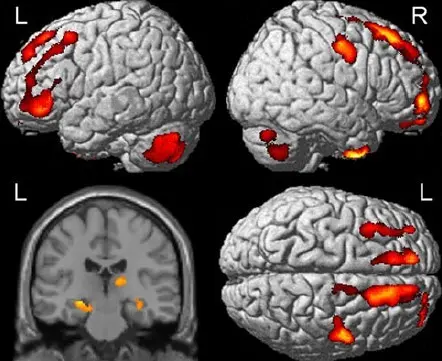
Regional gray matter density declines in chemotherapy-treated breast cancer patients from baseline to one month after chemotherapy.
Among her current studies, McDonald serves as the Indiana University site PI for the Thinking and Living with Cancer study, which examines cognitive and psychosocial functioning and brain changes among older women with breast cancer.
In studies examining the potential efficacy of treatments for cancer and treatment-related cognitive changes, McDonald and colleagues have investigated the utility of the Memory and Attention Adaptation Training (MAAT) cognitive-behavioral therapy approach to help patients manage cognitive changes after cancer treatment. Initial work has shown that this approach is acceptable to patients and feasible to implement, and preliminary data indicate cognitive benefit. This intervention is the focus of a current multicenter MPI randomized clinical trial (R01CA244673, NCT0486530).
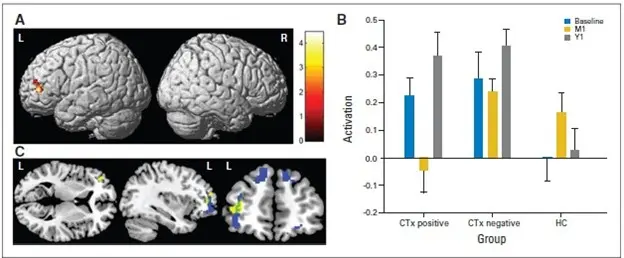
Alterations in brain activation over time (3-back 0-back contrast). (A) Brain activation decrease in patients with breast cancer treated with chemotherapy (CTx positive) from baseline to one month after chemotherapy completion (M1) with return to baseline levels of hyperactivation at one year after M1 visit (Y1), displayed over atlas template. (B) Activation pattern at left frontal peak displayed in (A) shown graphically for all groups at all time-points (MNI coordinates 38, 44, 6; cluster means extracted by using MarsBaR version 0.4246). These frontal changes in CTx-positive patients overlapped with regions of gray matter change following the same pattern of change over time.
McDonald is also an MPI on a national multicenter study of computerized cognitive training for cognitive symptoms after cancer treatment, conducted through the NCORP network of community oncology sites (R01CA276222, NCT05896189). Preliminary data suggests benefits in daily functioning, and this large, well-powered study is designed to test the intervention's efficacy.
Additional work in cancer populations has included studies of children treated for acute lymphoblastic leukemia (ALL) and pilot work to adapt the MAAT intervention for young adult survivors of childhood cancer.