Infections following a transplant can significantly complicate a patient’s recovery, with symptoms lasting for years in some cases and, at their worst, resulting in death. Monitoring for infections and keeping them at bay is a top priority. Thanks to a new program in the Department of Medicine’s Division of Infectious Diseases — funded by the generous gift of an Indiana University School of Medicine alumnus and former faculty member — transplant patients in Indianapolis now have the specialists they need.
The Department of Medicine now has two specialists in transplant infectious diseases on its faculty.
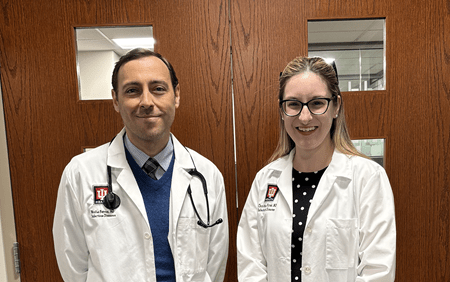
Nico Barros, MD, was hired in 2019, becoming the first transplant infectious disease subspecialist at IU School of Medicine. He now serves as the Transplant Infectious Diseases Director at IU Health University Hospital, where abdominal and stem cell transplants are performed, and is working to build out the Wheat Family Program of Excellence for Transplant Infectious Diseases.
A gift from Lawrence Joseph Wheat, MD, and his family established the program in 2024, and enabled the department to pursue its goal of creating a team of transplant specialists within the infectious diseases division.
In summer 2025, Christina Vojtek, MD, stepped into the same director role at IU Health Methodist Hospital, where heart and lung transplants are performed.
Staying vigilant against infections — and having a team of specialists dedicated to that task — will only improve outcomes for local transplant recipients, said Samir Gupta, MD, MS, Division Director and David H. Jacobs Professor of Infectious Diseases.
The division hopes to recruit even more specialists for these essential roles in the coming years, he said. It is also on track to begin offering fellowship training in transplant infectious diseases — an added third year of subspecialty education that would build on the division’s existing two-year fellowship — by 2027.
This growth aligns with the expansion taking place across IU Health, including the construction of the new IU Health Downtown Indianapolis Hospital — the largest healthcare campus in the United States. The new campus will bring together providers from IU Health University Hospital and IU Health Methodist Hospital in one centralized location.
The creation of a unified Transplant Infectious Diseases service within the new Academic Adult Health Center marks a defining step forward for IU Health. For the first time, thoracic and abdominal transplant programs will operate within a single integrated ecosystem, enabling standardized practices, education and research collaborations.
With approximately 550 solid organ transplants, 180 autologous and 60 allogeneic stem cell transplants, and 60 CAR-T therapies performed annually, this alignment will strengthen clinical care while expanding opportunities for translational and clinical research. It will also foster a dynamic environment for education and training.
This growth is thanks to the Wheat family, Gupta said.
Wheat is an accomplished infectious disease specialist who conducted groundbreaking research during a career at IU School of Medicine that spanned more than two decades.
As a clinician-researcher at the height of the AIDS epidemic, Wheat developed specialized testing for the fungal lung infection histoplasmosis, which commonly affects people with HIV. The infection causes flu- or pneumonia-like symptoms and is often misdiagnosed, according to the U.S. Centers for Disease Control and Prevention. In patients with AIDS or other immunocompromising conditions — such as those who have undergone transplantation or are treated with medications for inflammatory diseases like arthritis — histoplasmosis can be life-threatening if diagnosis is delayed or missed.
Wheat subsequently founded MiraVista Diagnostics, an Indianapolis-based clinical laboratory where he continues to build upon his discoveries and develop additional specialized tests for serious fungal infections.
After earning his undergraduate degree from Indiana University, Wheat completed his medical degree, internal medicine residency and infectious disease fellowship at the Indiana University School of Medicine. He joined the faculty at the encouragement of his mentor and divisions founding director, Arthur White, MD.
Given this legacy, it was fitting to have a transplant infectious diseases program at IU that carries Wheat’s name, Gupta said. Wheat’s generosity will help the division further an important aspect of its clinical mission: improving the health of local communities by preventing and treating a variety of infectious diseases.
David Aronoff, MD, the John B. Hickam Professor of Medicine and Chair of the Department of Medicine — and an infectious diseases physician himself — emphasized the national significance of this growth.
"The demand for highly trained experts in transplant infectious disease is growing, as the science and practice of organ transplantation continues to expand," he said. "The Department of Medicine is grateful to the Wheat family for their transformative investment in our program. Their generosity will help us provide the highest level of care for transplant recipients, train infectious disease leaders in this specialized field and make impactful discoveries that ensure the best health for transplant recipients everywhere."