Maria Walker was in fifth grade when she discovered her calling. One of her best friends in Gary, Indiana, had been diagnosed with leukemia and needed to travel to Riley Hospital for Children in Indianapolis for treatment. Walker volunteered to go along for support — and wore her favorite yellow pants.
At the hospital, she met the late Moses Spray, one of the first graduates of the radiation therapy program started at the Indiana University School of Medicine in the 1970s. It began as a certificate program, then became an associate’s degree and now is the state’s largest Bachelor of Science program for radiation therapists. Walker showered Spray with questions and left knowing she wanted his job. She wanted to help people beat cancer.
Years later, Walker met Spray again, this time as a student in the IU Radiation Therapy program where he was on faculty. “You were the little girl in the yellow pants,” she recalled him saying. Walker, a 1992 graduate, now serves as the program’s director.
Today, IU graduates make up 86% of central Indiana’s practicing radiation therapists. The Radiation Therapy program boasts a 100% job placement rate with graduates working in hospitals and clinics throughout Indiana, across the nation and internationally, including graduates in London, Saudi Arabia and Canada.
“We can’t keep up with the number of radiation therapists that are needed,” said Walker, MA, an assistant professor of clinical radiation oncology at the IU School of Medicine. “People call and recruit our graduates, even outside of the state.”
Like Walker, most radiation therapists have a personal connection to the field. Her childhood friend, husband and father all died from leukemia. “Radiation therapists are led by their hearts,” she said.
‘One of the happier places in the hospital’
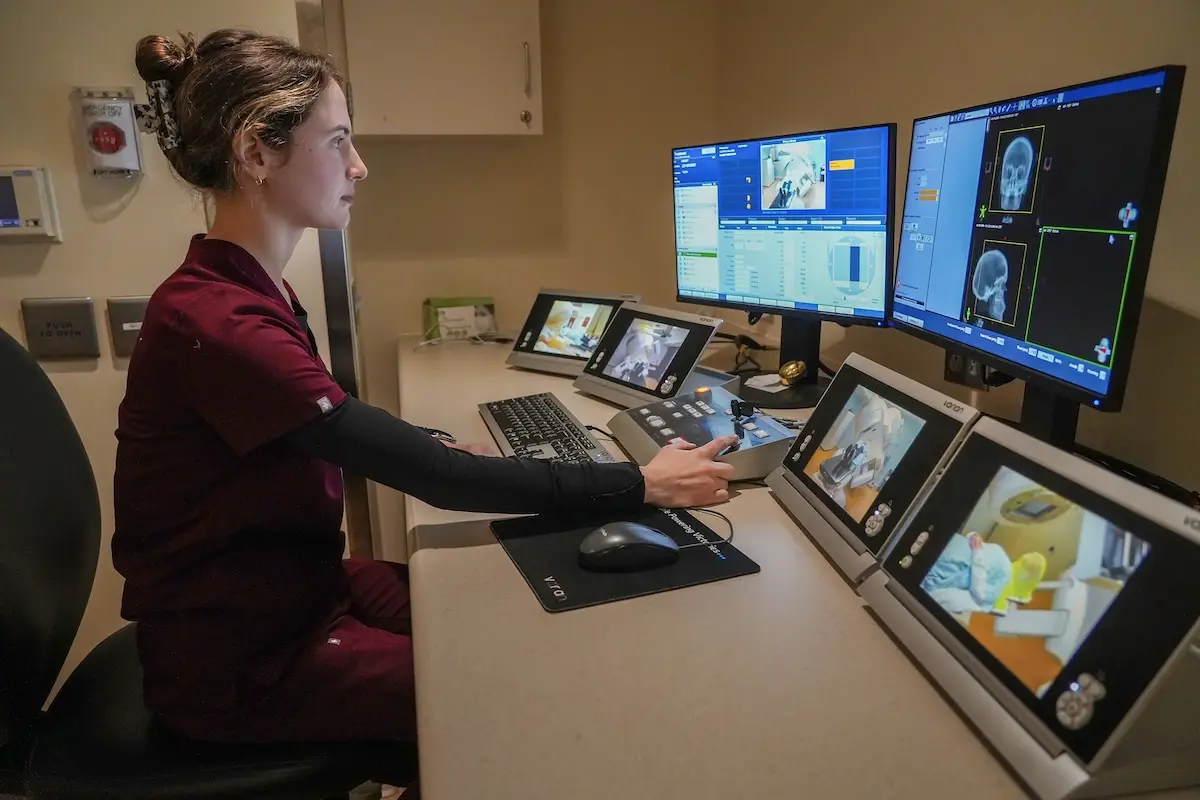
 Today’s radiation therapy treatments are increasingly precise, using advanced imaging and targeted radiation. Therapists must keep up with the ever-changing technology, and they are the only professionals licensed to operate these specialized machines.
The job also requires skills that aren’t easily taught — things like empathy, compassion, kindness and encouragement.
“Some patients have great support systems, and some don’t — you get to be the person who helps them through it,” said Megan Knight, MA, a 2017 program graduate who is now an assistant professor of clinical radiation oncology and serves as the program’s clinical coordinator. Her personal “why” for choosing the field stems from watching both her grandfather and father battle cancer.
Radiation therapists treat patients of all ages and with various types of cancer, targeting radiation to any part of the body. Walker’s youngest patient was 1 day old, while Knight’s oldest patient was 101.
“The unique thing about our career is we get to see patients almost every day for eight weeks,” Knight said. “We have the joy of getting to know each patient on an individual level, down to the type of music they want to listen to.”
Some patients prefer the room to be quiet during the approximately 15-minute treatment session while others want their therapists to continually communicate about what’s happening. The bonds built during those anxiety-filled weeks can last a lifetime.
“There is no better feeling than seeing a patient reach that final day and watching them ring that victory bell,” Knight said. Contrary to what people might think, she added, working in radiation oncology isn’t overly sad. “It’s one of the happier places in the hospital because there’s hope.”
‘This job gives you purpose.’
 Delaney Townsend is in the final year of her training as a radiation therapist, but on a recent day at the IU Health Simon Cancer Center, she’s about to experience what it’s like to be a patient coming in for radiation. Rather than being at the controls adjusting settings on the Varian TrueBeam linear accelerator for targeted radiation, Townsend is the one lying on the table in a sterile but peaceful room looking up at softly illumined ceiling tiles featuring falling autumn leaves.
Knight enters carrying a pliable mesh thermoplastic mask, and two classmates gently pull it across Townsend’s face, so it conforms to her exact shape before hardening. It doesn’t hurt, and there are holes for breathing. The custom mask is worn throughout radiation treatments to ensure a patient is kept still as the machine delivers targeted therapy to marked locations in the head and neck areas. For children, the radiation therapists make it fun by painting the masks to look like a favorite superhero or princess.
Some patients like eye holes to be cut out so they can see better, while others prefer to keep their eyes shut and meditate or pray during the treatment.
“Hearing the machine move but not knowing what it’s doing or where you’re lying spatially in relation to the machine was a bit disorienting,” Townsend said after her mock treatment. “I realized I need to be educating my patients on what’s happening to them next.”
A native of California, she chose to come to IU after researching programs across the country. IU stood out as one of the nation’s oldest accredited bachelor’s degree programs for radiation therapy. Her training has confirmed the field offers “everything you could want” in a healthcare career.
“These patients don’t know what the future holds for them, but they come to treatment every day and put their full trust in you and the doctors and team, that we are there to help and support them,” Townsend said. “We’re all in it together.”
That’s the sense classmate Rylee Fuller got when she took her grandfather to his radiation therapy appointments — her reason for transferring from IU East into the Radiation Therapy program at IU School of Medicine.
“They all looked like they enjoyed their jobs and had a passion for it,” Fuller said. “I thought, this is something I could love.”
A moment that solidified her calling came recently while working alongside a radiation therapist during Fuller’s in-clinic training. A patient with a recurrence of cancer was back for additional radiation and broke down in tears in the treatment room.
“We consoled her, telling her that coming back shows how perseverant she is,” Fuller said. “We’re not just there running the machine and delivering the treatments; we’re there as support for these patients. Even in the sad days, this job gives you purpose.”
Meet IU Radiation Therapy graduate Lindsey Smith, Class of 2021
 Lindsey Smith is a 2021 graduate who now works at the Hux Cancer Center in Terre Haute, Indiana. Like Fuller, she has a personal connection which fueled her passion — her mom was treated for breast cancer when Smith was in high school.
Radiation therapy is a career that requires technical skills while also being patient-focused. Smith shared how her training at the IU School of Medicine prepared her for the fulfilling work she does each day.
Question: What do you think is special about the Radiation Therapy program at IU School of Medicine?
Smith: The quality of didactic education along with the comprehensive clinical experience is incredible. I truly felt competent and confident taking my boards and stepping into my role as a therapist upon graduation.
Q: What do you do in a typical workday?
Smith: In a typical day, I work with a partner to treat between 20 to 25 oncologic and benign cases on a Varian TrueBeam linear accelerator.
Q: What is the most challenging part of your work, and how do you handle those stressful moments?
Smith: When working at a busy facility, it can be difficult to remain efficient while also taking the time to connect with patients. We are often pulled in many different directions throughout the day, so focusing on the patient in front of me helps me in those times.
Q: What do you most enjoy about your work?
Smith: I love that my work is always changing. The field is evolving every day.
Q: What keeps you motivated in your role as a radiation therapist?
Smith: My patients. Seeing their daily struggles helps me keep my mindset on the things that matter.
Q: What advice do you have for someone considering this career?
Smith: Shadow! There’s no better way to find out if a career is for you than to see it firsthand.
Discover more about the many undergraduate Health Professions Programsat IU School of Medicine, including the competitive field of Medical Laboratory Science — specimen specialists who work behind the scenes to help determine causes of disease.