The research was carried out by E. Vernon Hahn, MD (1891-1959, MD 1920), and Elizabeth Biermann Gillespie, MD (1898-1972, MD 1925*), and was reported in the February 1927 issue of Archives of Internal Medicine in their article titled "Sickle Cell Anemia: Report Of A Case Greatly Improved by Splenectomy. Experimental Study of Sickle Cell Formation, pages 233-254."
Hahn and Gillespie profiled a 4-year-old patient (Curtis C) who was admitted to Riley Hospital for Children in 1925, one year after the hospital opened. Curtis C. was the 14th patient with sickle cell anemia described and studied in the medical literature. While preparing to test the effect of formaldehyde on sickle cells, Hann and Gillespie noticed that when they shook a tube of solution containing distorted red blood cells, the cells regained their disc shape. Hypothesizing that a lack of oxygen encouraged sickling, they exposed the cells to gases that did not contain free-ranging oxygen. In nearly every case, the cells sickled.
Hahn and Gillespie suggested that anoxia caused red blood cell sickling by demonstrating that shape changes could be induced by saturating a cell suspension with carbon dioxide.
They made this important discovery in 1927 about the nature of sickle cell anemia with their finding that red blood cells sickled when oxygen was removed from them. Hahn and Gillespie concluded that “the only specific cause for active sickle cell anemia is the unique hereditary anomaly of the red corpuscles which predisposes to it.” This discovery eliminated other hypotheses about the characteristics of the disease and led to better understandings about how to treat it.
The work by Hahn and Gillespie was part of several similar cases reported after sickle cell anemia was first described in 1910 and supported the idea that this was a new disease entity and provided enough evidence for a preliminary clinical and pathological description. These seminal studies were noted by Linus Pauling, who was the first to hypothesize in 1945 that the disease might originate from an abnormality in the hemoglobin molecule.
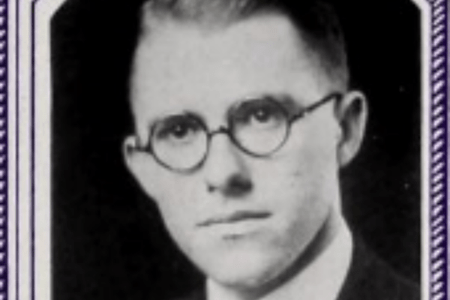
Hahn graduated cum laude from the IU School of Medicine and was awarded the Marcus Ravdin Medal, the school’s highest award for scholarship in 1920. Upon graduation, Hahn entered private practice in Indianapolis and was an instructor in surgery at the IU School of Medicine.
Following World War II, Hahn became clinical professor of psychiatry at IU School of Medicine, served as neurosurgeon to the Indianapolis City Hospital, was consulting surgeon to the Sunnyside Sanatorium (for patients with advanced tuberculosis), a staff member at St. Vincent Hospital, and president of the medical staff of Methodist Hospital.
Gillespie served her internship at the Robert Long General Hospital and the James Whitcomb Riley Children's Hospital in Indianapolis. She was awarded a cum laude degree at graduation. She was honored in later years for this early work by the Indiana Medical Alumni Association. In later years, she was on the staffs of Christ and Bethesda Hospitals in Cincinnati. She was active in the Women's Medical Society of Cincinnati, having served as its president.
To learn more about the contributions of Hahn and Gillespie to the understanding and treatment of sickle cell anemia, visit: Norma B. Erickson, Indiana’s Contribution to the Understanding and Treatment of Sickle Cell Anemia, 1927-2002, 2026 George H. Rawls, MD Memorial Lecture on the History of Minorities & Medicine, September 21, 2025, Indiana Medical History Museum.
Groundbreaking research by two IU School of Medicine graduates led to advancement of sickle cell anemia treatment
Karen Bruner Stroup Feb 10, 2026

Elizabeth Bierman, previous IU School of Medicine student. | Photo courtesy of 1925 Indiana University Arbutus (Yearbook)

Karen Bruner Stroup
Karen Bruner Stroup currently sits on the Riley Hospital Historic Preservation Committee. Karen works to ensure that IU School of Medicine and Riley Hospital history are shared with the Indianapolis community, and Indiana as a whole.
E. Vernon Hahn and Elizabeth Bierman Gillespie, Sickle Cell Anemia: Report Of A Case Greatly Improved by Splenectomy. Experimental Study of Sickle Cell Formation, Archives of Internal Medicine, February 1927, pp. 233-254.
Journal of the Indiana State Medical Association (1926), News, Notes, and Personalsp. 489: https://archive.org/details/journalofindiana1911indi/page/489/mode/1up?q=%22sickle+cell+anemia%22
*It appears that Dr. Elizabeth Bierman Gillespie was a 1925 graduate of the Indiana University School of Medicine. See: 1925 Indiana University Arbutus, p. 126 at: Elizabeth Bierman: https://archive.org/details/arbutus1925indi/page/126/mode/2up?q=Bierman
Dr. Bierman married Dr. William P. Gillespie (’23): https://archive.org/details/arbutus00indi_22/page/104/mode/2up?q=%22William+Gillespie%22
1926 IU Alumni Quarterly, p. 525, reported the Bierman-Gillespie June 1926 marriage and their living in Cincinnati to practice medicine: https://babel.hathitrust.org/cgi/pt?id=uc1.b2872372&seq=583&q1=Gillespie
Paul S. Frenette and George F. Atweh, Sickle cell disease: old discoveries, new concepts, and future promise, J Clin Invest. 2007 April 2; 117 (4): 850-858: https://pmc.ncbi.nlm.nih.gov/articles/PMC1838946/
Sickle Cell Secrets: Medical History, Proto magazine, September 27, ,2007, Massachusetts General Hospital:
https://protomag.com/medical-history/sickle-cell-secrets/
E. Vernon Hahn. Encyclopedia of Indianapolis: https://indyencyclopedia.org/e-vernon-hahn/
Vernon Hahn/1920 Indiana University Arbutus (p. 201): https://archive.org/details/arbutus00indi_19/page/201/mode/1up?q=Hahn
Elizabeth Bierman Gillespie. Find a Grave: https://www.findagrave.com/memorial/78938532/elizabeth-gillespie
Sickle Cell Disease gains advocacy at the Indiana Medical History Museum, NUVO, September 15, 2025: https://www.nuvo.net/wellness/sickle-cell-disease-gains-advocacy-at-the-indiana-medical-history-museum/article_3607ae05-1d1b-41cf-a728-fddf05b2ea19.html?_evDiscoveryPath=/
Richard L. Schreiner, MD, Edwin L. Gresham Professor Emeritus of Pediatrics, Indiana University School of Medicine; Retired Chairman, Department of Pediatrics; Retired Physician-in-Chief, Riley Hospital for Children at IU Health; and Chairman, Riley Hospital Historic Preservation Committee;
Karen Bruner Stroup, PhD, Retired Director, Community Education and Child Advocacy, Riley Hospital for Children at IU Health; Secretary, Riley Hospital Historic Preservation Committee