Jeremy Bolin once spent his days weightlifting, fishing and working hard to provide for his family. Now, the 50-year-old measures his energy in small tasks: unloading the dishwasher, folding laundry or walking across a room without losing his balance.
A stroke in 2021 “changed nearly every part of daily life” for the Indiana University alumnus. But it also inspired a new mission: helping young stroke and brain injury survivors navigate the non-medical challenges that often accompany recovery.
Bolin lives in Pendleton, Indiana, with his wife and daughter and spent nearly three decades working in environmental science and engineering before suffering a hemorrhagic stroke.
“I never thought two minutes about someone having a stroke in their 40s,” said Bolin, who was an active and healthy 45-year-old at the time when the warning signs of stroke appeared suddenly during a workout. He became dizzy, off balance and developed a severe headache.
“I usually went hard at the gym with weight training and one day, out of nowhere, I started feeling really awful,” Bolin recalled. “I left and came home, and it got worse and worse over the next half-hour.”
Within hours, Bolin arrived at Indiana University Health Methodist Hospital and underwent emergency brain surgery after a blood vessel ruptured in his cerebellum — the area of the brain responsible for balance and coordination.
Richard Scheer, MD, assistant professor of clinical neurology at the Indiana University School of Medicine, said Bolin is “the textbook story of undiagnosed hypertension,” or high blood pressure, a condition in which the force of blood pushing against the artery walls remains consistently too high, causing the heart to work harder over time.
Stroke is the fifth-leading cause of death in the United States, and for most of the nearly 800,000 Americans who suffer a stroke each year, hypertension is the primary cause, according to the Centers for Disease Control and Prevention. Although nearly 120 million adults in the U.S. have high blood pressure, about 41% of them have no idea.
“They call it the silent killer for a reason,” Scheer said. “In middle-aged adults, undiagnosed or untreated high blood pressure can lead to the same kinds of blood vessel damage we typically see in patients in their 80s. When blood pressure remains high for a long period of time, it accelerates that damage and can increase the risk of stroke.”
Bolin was hospitalized for more than a month and had to re-learn how to walk through physical therapy.

Although much of his recovery is “invisible to others,” Bolin said the stroke’s physical and cognitive effects have persisted, preventing him from returning to work.
“People have looked at me and said, ‘Wow, you’re looking great.’ But they haven’t seen me get up, walk across the room, turn around real fast and just fall down,” Bolin said. “It takes so much energy to do the smallest thing.
“It has affected me a lot mentally, too. I was a hardworking, hands-on dad — and now I’m not able to do a lot of the things I enjoyed.”
Scheer said many stroke survivors face long-term challenges that go beyond physical recovery. Difficulties with attention, focus and concentration are common after a stroke, and while some patients improve over time, others will continue to experience these issues. Depression is also common after a stroke.“Stroke is the number one leading cause of long-term disability in the United States,” he said. “Depending on the severity of it, some patients have to pivot and adjust to a new reality, and that can be very difficult.”
A calling to help others
While Bolin and his wife had savings and long-term disability insurance, Bolin realized many families are not as financially prepared for a life-changing medical emergency like a stroke. Some struggle to pay mortgages, modify homes for accessibility or navigate the process of applying for disability benefits.
To help address those gaps, Bolin founded the nonprofit Unfinished Business in 2024. The organization focuses on supporting stroke and traumatic brain injury survivors “during their peak income earning years” at ages 30 to 60, by helping them access the resources they need to move forward.
In addition to providing legal aid, help with financial planning and home accessibility, the organization also provides post-secondary education scholarships to children of survivors, helping them pursue their dreams despite family hardship.
“When I went to physical therapy and support groups, I noticed I was always the youngest person in the room,” Bolin said. “When a stroke or brain injury happens during your prime working years, it can make life 10 times harder and more expensive at a time when some are already struggling to pay their housing or medical bills. After spending a couple of years doing very little following my own stroke, I felt called to do something — to help others get back on their feet.”
Scheer said Bolin’s nonprofit addresses critical needs that are often overlooked in medical care.
“When I heard about what Jeremy was doing, I immediately shared the information with our case management team,” Scheer said. “I know other patients who could really benefit from these resources.”
So far, the organization has provided financial support to local families during the holidays. Bolin hopes its first major fundraiser — a golf outing scheduled for May 30 at Fall Creek Golf Club in Pendleton — will help build momentum for future scholarship programs.
“If I can help a few families a year,” Bolin said, “then that’s doing my part.”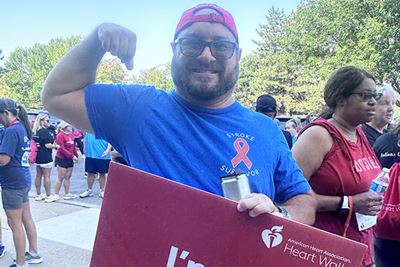
Leading innovation in stroke treatment and recovery
Bolin credits his recovery in part to the care he received from Scheer and the stroke specialists at the IU School of Medicine and IU Health.
“I am very thankful for all the folks that were involved in my case because of the severity of my stroke, my chances of survival were not great,” Bolin said recently from his Pendelton home. “Now, I’m about to go pick up my daughter from school and take her to dance. If I didn’t have the team at IU there for me, there’s a chance I could not be around and able to do that.”
Scheer said IU’s team-based approach gives patients access to highly specialized stroke care at every stage of recovery while also advancing the field through four active clinical trials aimed at improving outcomes for patients.
“One thing that really sets us apart is our team of eight board-certified vascular neurologists,” said Scheer, who serves as the interim center director for the Center for Neurovascular Disorders, part of the IU School of Medicine-IU Health Neuroscience Institute.“That level of expertise is extremely unique, and no other hospital system in Indiana offers the same depth of specialized stroke care. We’re able to provide a higher level of care and continue advancing stroke treatment through research, education and clinical programs, all aimed at improving outcomes for our patients.”
By sharing his story during National Stroke Awareness Month in May, Bolin hopes other survivors know that resources like Unfinished Business are available to support them throughout recovery. He also hopes his experience reminds young adults of the importance of getting annual checkups.
“I didn’t know I had an issue with blood pressure in part because I didn’t go get annual physicals done. I used to think, ‘I’ll go to the doctor when I’m near death.’ Well, that actually happened,” Bolin said. “As I’ve learned, many strokes can be prevented, so take care of yourself before it’s too late.”